


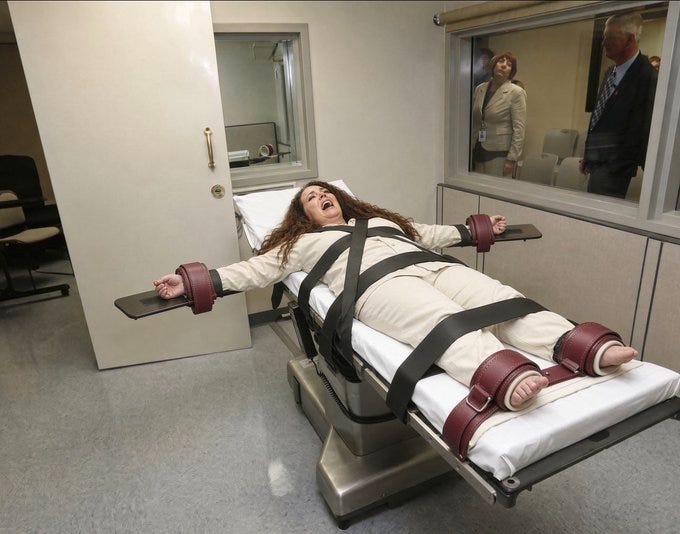
Wednesday night at Riverbend Maximum Security Prison in Nashville, the state of Tennessee attempted to execute Christa Gail Pike by lethal injection. Then it attempted again. Two hours and seven needles later, ambulances were pulling up to the prison and Pike, who was supposed to be dead, was being loaded into one of them. As of this morning she is alive, in critical condition, receiving what her lawyers are calling lifesaving medical care.
The Tennessee Department of Corrections issued a statement afterward. “The Tennessee Department of Correction followed every step of the State’s lawful, established execution protocol approved by the Attorney General’s Office.”
Every step of the protocol. Twice. Seven needles. Two doses of pentobarbital. One woman’s arm turned purple. Two and a half hours. And she is in a hospital right now, alive, with a prognosis her own attorneys describe as unclear.
This is not a story about whether Christa Pike deserved to die. That conversation is legitimate and will be had. She was convicted in 1996 of the 1995 murder of Colleen Slemmer, a fellow student at Job Corps, a federal vocational training program. Slemmer was beaten, tortured, and killed. Pike was 18 at the time. She was convicted and sentenced to death. The crime was real. The sentence was lawful. The victim’s family has waited 31 years. None of that is in dispute.
This is a story about what a government does in the name of its people. And last night, in the name of the people of Tennessee, something happened that no democracy should be comfortable calling justice.
What happened, in sequence
The execution was originally scheduled for Wednesday morning. Last-minute legal appeals from Pike’s attorneys delayed it into the afternoon. A three-judge panel of the 6th Circuit Court of Appeals temporarily blocked the execution. The Supreme Court vacated that stay Wednesday evening, clearing Tennessee to proceed.
The state began its lethal injection protocol. The drug used was pentobarbital, a sedative that Tennessee and roughly a dozen other states have chosen for executions while the Department of Justice has formally renounced it. Technicians attempted to establish IV access. Then attempted again. Then again. At least seven needles were inserted into Pike’s arm over the course of an hour, according to one of her lawyers who witnessed the procedure.
Two full rounds of the lethal injection protocol were administered. Pike remained alive. Her right arm had turned purple. Her attorneys filed an emergency appeal to halt the execution and get her immediate medical care. Several ambulances arrived at the prison. Pike was transported to a hospital where she remained in critical condition the following morning.
The Tennessee Department of Corrections spokesperson then declined to take media questions. The governor, Bill Lee, suspended all remaining executions in 2026 and announced a review.
This was not Tennessee’s first failure this year. On May 21st, the execution of Tony Carruthers was called off after more than an hour of attempting to establish IV access. The state granted Carruthers a one-year stay. The same doctor who oversaw the Carruthers attempt oversaw what happened to Christa Pike last night. The same doctor. The second failure in four months. Under the same medical supervision. Inside the same walls.
The protocol that keeps failing
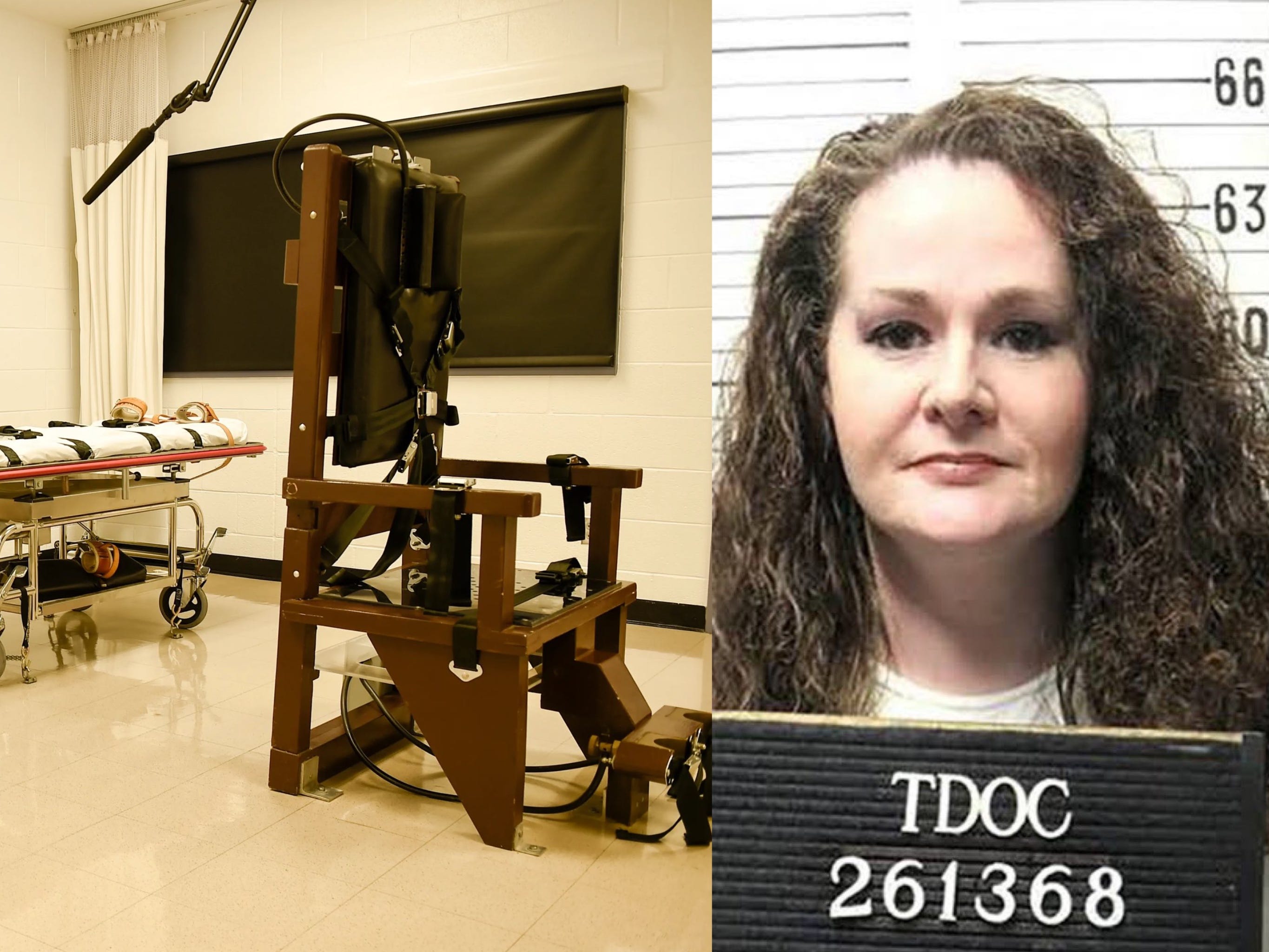
After a nearly five-year hiatus, Tennessee resumed executions this year with what it called a new lethal injection protocol using pentobarbital as a single drug. Death row inmates filed suit in the spring calling it a torturous death. The lawsuit raised something specific and important: the protocol is one page long on the use of lethal injection chemicals. One page. It does not include details on how the drugs will be acquired, tested, or stored. It does not specify the qualifications or oversight requirements for the people administering the drug. It contains no safeguards to ensure the drug is handled properly before it reaches the needle.
This matters because Tennessee has been here before. The governor halted executions in 2022 after the state was found to have failed to follow its own lethal injection protocol. A state-commissioned report found the state had failed to test its lethal injection drugs for bacterial endotoxins. That failure likely resulted in the execution of at least two people using expired, compromised, or untested drugs.
Read that sentence again. At least two people were likely killed using compromised drugs, without knowing it, before the problem was discovered. The state then took a five-year pause, announced a new protocol, resumed executions, and has now failed twice in four months with a one-page procedure and the same supervising physician.
The Department of Corrections said it followed every step of the protocol. It did. That is exactly the problem. The protocol is insufficient. Following it completely still produces a woman in a hospital with a purple arm and an unclear prognosis.
What the law says and what it cannot resolve
The Eighth Amendment to the United States Constitution prohibits cruel and unusual punishment. The Supreme Court has consistently held that this standard applies to methods of execution. The legal test, established in Baze v. Rees in 2008 and refined in Glossip v. Gross in 2015, requires that an inmate challenging a lethal injection protocol demonstrate that it presents a substantial risk of serious harm. Attorneys for death row inmates across the country have argued for years that pentobarbital, administered without proper protocols, proper personnel, and proper oversight, meets that standard. Courts have mostly disagreed.
Last night in Nashville provided a factual record that those legal arguments have never previously had. Two failed administrations of the drug. Seven needles. An arm that turned purple. A living woman in a hospital. Whatever the courts decide about the constitutional standard going forward, the evidentiary picture of what pentobarbital does when administered in uncertain conditions is now documented in real time, by witnesses, in a maximum-security prison in Tennessee.
The Supreme Court vacated the stay that would have prevented this. Five justices decided Wednesday evening that Tennessee could proceed. Three justices dissented. Whatever their reasoning, those five justices made a decision that led directly to what happened in that room last night. That is not an accusation. It is a fact about how institutional decisions compound into human outcomes.
The case for ending this
This letter is going to say something plainly that we ask you to hear regardless of where you stand politically on capital punishment.
The United States is one of only 55 countries in the world that still carry out executions. Every other G7 nation, every member of the European Union, every NATO ally except the United States, abolished the death penalty decades ago. Since 1973, more than 190 people have been exonerated and released from death row after evidence emerged that they were wrongfully convicted. One hundred and ninety people who came close enough to what happened to Christa Pike last night to feel it as a real possibility. Some of them came much closer than that.
The argument for capital punishment rests on three pillars: deterrence, justice for victims, and the incapacitation of the irredeemably dangerous. Each of those pillars has been weakened substantially by decades of evidence. Every major study on deterrence has failed to find a reliable relationship between the existence of the death penalty and reduced murder rates. States without the death penalty do not have higher homicide rates than states with it. The deterrence argument does not survive contact with the data.
The justice argument is the most emotionally powerful and the hardest to dismiss. Colleen Slemmer was a real person. She suffered a real death at the hands of a real killer. Her family has waited 31 years. The desire to see that wrong answered with something final and proportional is a human instinct that does not require justification. It is simply felt. This letter does not ask anyone to stop feeling it.
But justice and the state’s capacity to deliver it reliably are two separate things. A system that has exonerated 190 people since 1973, that has executed people with compromised drugs it did not test, that failed twice in four months in the same facility with the same doctor, is not a system that can be trusted to deliver the permanent, irreversible sentence of death with the certainty that permanence and irreversibility demand. The standard for a sentence that cannot be undone should be higher than the standard for every other sentence combined. The American death penalty system, as it actually functions, does not meet that standard. It has not for a long time.
The incapacitation argument, that some people are so dangerous they cannot safely be imprisoned for life, has been functionally answered by the existence of supermax facilities. People can be permanently and safely removed from society without being killed. The question of whether they should be killed for the symbolic or punitive value of the act is the question the country has been avoiding with procedural arguments for half a century.
The governor who said carrying this out is among the state’s most serious responsibilities
Governor Bill Lee’s statement Wednesday night deserves to be quoted directly. “Carrying out a lawfully imposed sentence is among the state’s most serious responsibilities. The people of Tennessee expect it to be done in a manner that is not only legal and constitutional, but is effective.”
He suspended the remaining 2026 executions after releasing that statement. He did the right thing in that specific moment. But the word effective in that sentence is the one that should stop every thinking person who reads it. The standard the governor of Tennessee is applying to the question of whether to kill a human being is whether the state can do it effectively. Not whether it should. Not whether the system that produced the sentence is reliable enough to justify the permanence of the outcome. Whether it can be done effectively.
That is a profoundly narrow way to think about the most irreversible act a government performs. Effectiveness is a standard for manufacturing, not for justice. A factory that fails quality control twice in four months shuts down and reviews its process. A criminal justice system that fails to kill someone twice in four months is doing something that requires more than a process review. It requires a reckoning with the question of whether the process should exist at all.

What comes next for Christa Pike
As of this morning, Pike is alive in a Tennessee hospital in critical condition. Her prognosis is unclear. One legal commentator noted that no governor will sign a new death warrant for a prisoner who received brain damage from a previously botched execution. Whether that is true legally is uncertain. Whether it is true politically is a different question. Whether it is morally acceptable to try again is the question no official in Tennessee has yet answered publicly.
Her attorneys have demanded the governor commute her sentence. The governor has said nothing about Pike’s future. The attorney general’s office, which approved the protocol, has said the department followed every step. The same doctor who oversaw both failures is presumably still employed.
Thirty-one years after Colleen Slemmer was killed. One year after another execution was called off in the same building. Seven needles. Two doses. Two and a half hours. One woman in a hospital.
Tennessee has 45 men and one woman on death row. The one woman is Christa Pike. She was supposed to be the first woman Tennessee executed since 1837. She is instead the second person Tennessee failed to execute in four months.
The country is watching what Tennessee does next. More than that, the country should be watching what it decides about itself.
Because what happened Wednesday night in Nashville was not a malfunction. It was a mirror.
That is what this letter is for.
— US Daily Letter | October 1, 2026