


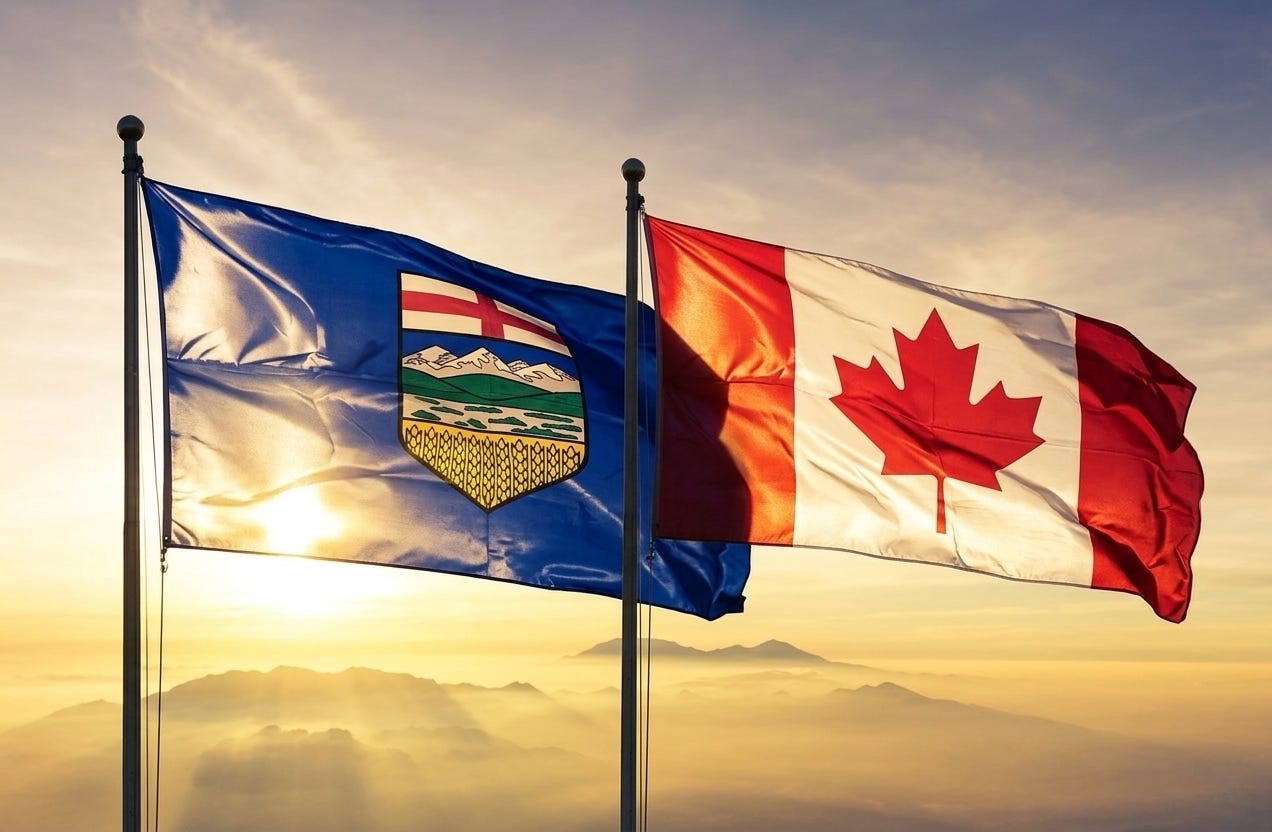
On Monday morning, May 4th, more than 300 supporters gathered outside the Elections Alberta headquarters in Edmonton, waving the provincial flag and chanting. Their leader, Mitch Sylvestre, walked up to the building carrying boxes of paper. Inside those boxes were nearly 302,000 signatures, enough under Alberta law to force a referendum on whether the province should leave Canada and become an independent country.
“This day is historic in Alberta history,” Sylvestre told the crowd.
Maybe. Or maybe it is the loudest chapter yet in a very old argument, one that has been building since the 1970s, one that Ottawa has never fully taken seriously, and one that is now, for the first time, moving through an actual legal process toward an actual vote.
From where we sit in the United States, this story looks almost familiar. A wealthy region that feels like it subsidizes everyone else. A cultural identity that does not match the national government in power. A political establishment dismissing the anger as fringe. We have heard versions of this before, from Texas to California to rural everywhere. The difference is that Canada actually has a legal framework for secession, and Alberta is now testing it.
Who Alberta is and why it matters
Alberta sits in the heart of western Canada, landlocked between British Columbia to the west and Saskatchewan to the east, with Montana running along its southern border. It has about 4.7 million people, roughly the population of Louisiana. Beneath its surface lies approximately 167 billion barrels of oil reserves, nearly four times the volume of the United States. The oil sands of northern Alberta are one of the largest proven reserves on the planet. Alberta does not just produce energy for Canada. It generates wealth that funds public services for people in provinces that have never come close to producing the same.
Each Canadian receives about $485 per year from Alberta-generated oil revenues alone. That is not separatist rhetoric. That is math. And that math is the central fact around which this entire argument turns.
The money fight, told plainly
Canada has a program called equalization payments. The federal government redistributes wealth from richer provinces to poorer ones so every Canadian can receive comparable public services. It sounds obviously fair until you sit down and look at the actual numbers.
Since the program began in 1957, Alberta has not received a single penny in equalization payments. Between 2015 and 2025 alone, the province of Quebec received $129 billion, for which Alberta footed most of the bill. From 2007 to 2022, Alberta’s net contribution to federal finances was $244.6 billion, the largest of any province. A quarter of a trillion dollars more sent to Ottawa than came back, over fifteen years, while the federal government was simultaneously passing policies designed to limit Alberta’s core industry.
Quebec’s equalization payments rose from $9.3 billion in 2014 to $14 billion in 2023. Alberta, despite economic crashes in 2015 and 2020, received nothing. And while Alberta’s pipelines were being blocked, Quebec passed a province-wide ban on new oil and gas development, then kept cashing checks funded in part by Alberta’s oil wealth.
If someone explained this to you at a kitchen table, you would probably feel the same way those 300 people in Edmonton feel.
The wound that never healed
The economic argument does not exist in a vacuum. In 1980, Pierre Trudeau’s federal Liberal government introduced the National Energy Program, a policy designed to assert federal control over Alberta’s oil revenues without the province’s consent. It contributed to the loss of tens of thousands of Alberta jobs and a recession that scarred a generation. That wound never fully closed. Every time a Liberal government in Ottawa passes a pipeline regulation, an emissions cap, or a climate policy that disproportionately burdens Alberta’s energy sector, it opens again.
Federal policies including pipeline review requirements, an oil tanker ban limiting exports to Asian markets, and a cap on oil and gas emissions have cost Alberta dearly. A 2024 Deloitte report estimated the emissions cap alone will make Alberta’s economy $191 billion smaller from 2030 to 2040. The money flows east. The regulations flow west. That combination is what fills those signature boxes.
How the movement got here
Alberta separatism is not new. It flares up during Liberal governments and low oil prices, then subsides. What is different now is that it has an actual legislative pathway. Premier Danielle Smith is not herself a separatist, but she lowered the threshold for citizen-initiated referendums from 20 percent of eligible voters to 10 percent and said she would respect the democratic process if the petition succeeded. It succeeded. But between 302,000 signatures and an actual independent country lies a distance most of the crowd in Edmonton may not have fully mapped.
Three walls standing in the way
The first wall is legal. Canada’s Clarity Act requires a clear majority on a clear question, followed by negotiations with the federal government. But it also gives the House of Commons, not the province, the power to decide whether the question and the majority are sufficiently clear. Ottawa has effective veto power over whether Alberta’s vote even counts. Actual separation would require a constitutional amendment, meaning all provinces and the federal government get a say.
The second wall is Indigenous, and it may be the most consequential. Most of Alberta’s land is covered by treaties made between the Crown of Canada and Indigenous peoples that predate the province’s legal existence. Those treaties were not made with a future independent Alberta. The Sturgeon Lake Cree Nation, the Athabasca Chipewyan First Nation, and the Blackfoot Confederacy have already filed legal challenges. Chiefs of Treaties 6, 7, and 8 stated they will not tolerate any action that undermines their treaties or their sovereignty. A court stay has already frozen the certification of signatures pending those challenges.
The third wall is economic. An independent Alberta would wake up the morning after independence surrounded entirely by foreign countries, Canada on three sides and the United States on the fourth. Every pipeline, every export route, every truck of grain moving to a port would need to cross someone else’s border. Alberta would lose $6.6 billion in Canada Health Transfers and $2.1 billion in social transfers annually. It would need to assume between $75 and $100 billion of Canada’s national debt, develop its own currency, negotiate trade deals from scratch, and build an entirely independent pension system. The existing trade agreement with the United States applies to sovereign states, not provinces. An independent Alberta would not automatically be covered.
The American angle
This story has not gotten nearly enough attention in the United States, and it should. The Alberta Prosperity Project met with the US State Department and Treasury three times between April 2025 and January 2026. Treasury Secretary Scott Bessent called Albertans “very independent people” and described the province as “a natural partner of the US.” The Financial Times confirmed that Trump administration officials discussed scenarios involving loan guarantees against Alberta’s natural resources. Alberta sits on 167 billion barrels of oil, borders Montana, and is deeply conservative and deeply frustrated with a federal government that Trump’s allies have spent two years painting as hostile to North American energy. The interest from Washington is real, calculated, and not entirely friendly to Canada’s territorial integrity.
Both sides of the argument, honestly
People who support secession are not lunatics. Many are ordinary workers who watch federal policies shut down pipelines that would have created jobs in their communities and feel like they are funding a country working actively against them. That belief is understandable even if the economics of independence tell a harder story.
On the other side, the former deputy premier of Alberta called the movement a form of treason. The anti-independence group Forever Canada gathered more verified signatures against separation than the pro-independence group collected for it. And the economic case against independence is largely uncontested by credible analysts. A landlocked country starting its independent life with a $75 to $100 billion debt assumption, no existing trade agreements, and legal challenges from Indigenous nations covering most of its land is a brutal starting position for any new country.
But economies are not the only reason people seek independence. The sense that your values and your industry are systematically undervalued by the government that claims to represent you is not nothing. Dismissing it as economically irrational misses the entire human point of what is happening in those Edmonton streets.
What likely happens next
If a referendum does happen, current polling puts independence support somewhere between 28 and 47 percent. That is unlikely to produce a yes vote. But a strong showing for independence, even a losing one, would fundamentally change the negotiating dynamic between Edmonton and Ottawa. Premier Smith almost certainly sees the petition as leverage, a way to force the federal government to address Alberta’s grievances without actually breaking up the country. That is probably the most realistic outcome. Not secession. Not the status quo. A renegotiation, forced by the credible threat of one.
Whether Ottawa is wise enough to take that off-ramp is a different question entirely.
The bottom line
Can oil-rich Alberta actually secede from Canada? Legally, barely, and only after years of constitutional battles, Indigenous negotiations, and federal consent that would be almost impossible to obtain. Economically, an independent Alberta faces challenges that would test any new nation. Politically, the votes are not there.
But the anger that fills those signature boxes is real, rooted in decades of legitimate grievance, and it is not going away. The question of whether Canada can hold itself together while its wealthiest province feels like a cash machine with no real vote is now, formally, on the ballot.
We should watch this closely. It involves our energy supply, our biggest trading partner, and a continent whose stability most Americans take completely for granted.
The boxes have been delivered. The argument is just getting started.
— US Daily Letter | May 8, 2026