


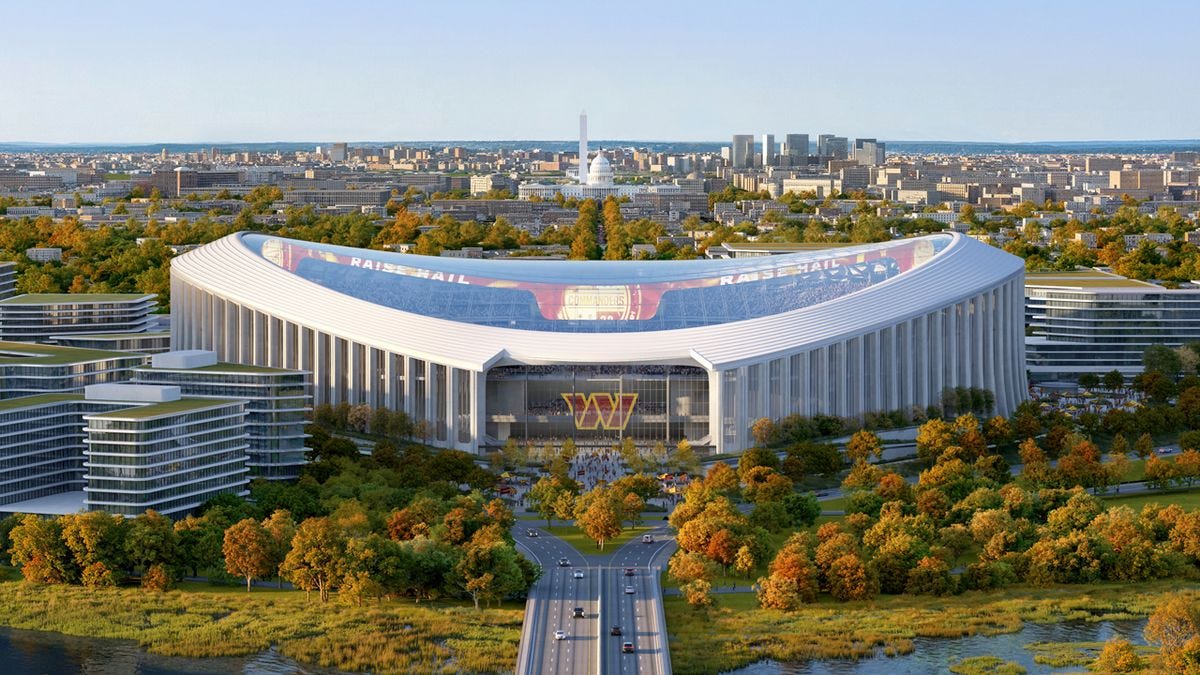
The Washington Commanders are coming home to D.C., and the stakes couldn’t be higher.
By 2030, a $3.7 billion domed stadium will rise on the old RFK site—70,000 seats wrapped in classical colonnades, a translucent roof, and sight lines designed to showcase the Capitol dome. But this isn’t just about football. It’s about whether D.C. can turn 190 acres of crumbling concrete into a thriving urban destination—or whether taxpayers just bought themselves an expensive lesson in the risks of publicly financed sports venues.
The Deal: Who’s Paying for What
The Commanders are putting up $2.7 billion and will cover any cost overruns. That’s the good news.
The District of Columbia is contributing over $1 billion in public money: $500 million for infrastructure, $356 million for parking garages, $202 million for utilities, plus $600 million for public transit improvements to handle game-day crowds and reduce congestion.
The structure matters: D.C. will own the stadium and lease it to the Commanders, who collect ticket and parking revenue. In return, the District projects over $5 billion in tax revenue over 30 years from what’s planned as a 180-acre mixed-use development—housing, retail, hotels, offices, and year-round events beyond just NFL Sundays.
That $5 billion projection is where optimism meets skepticism. Stadium deals nationwide have a mixed track record of delivering promised economic benefits. D.C. officials are betting this is different because of the scale, the location, and the fact that RFK currently generates essentially zero economic activity.
Mayor Muriel Bowser’s pitch: Anything is better than asphalt and a crumbling stadium sitting empty for decades.
What D.C. Stands to Gain
If this works—and that’s a significant if—the upside is transformative.
The RFK site has been dead space since 2019, when the stadium closed. Before that, it was underutilized for years. This is 190 acres of prime real estate two miles east of the U.S. Capitol, sitting along the Anacostia River, doing nothing.
The new development promises to activate that entire corridor. Picture something like the Wharf or Navy Yard: mixed-use, walkable, transit-connected, alive seven days a week instead of just during football season.
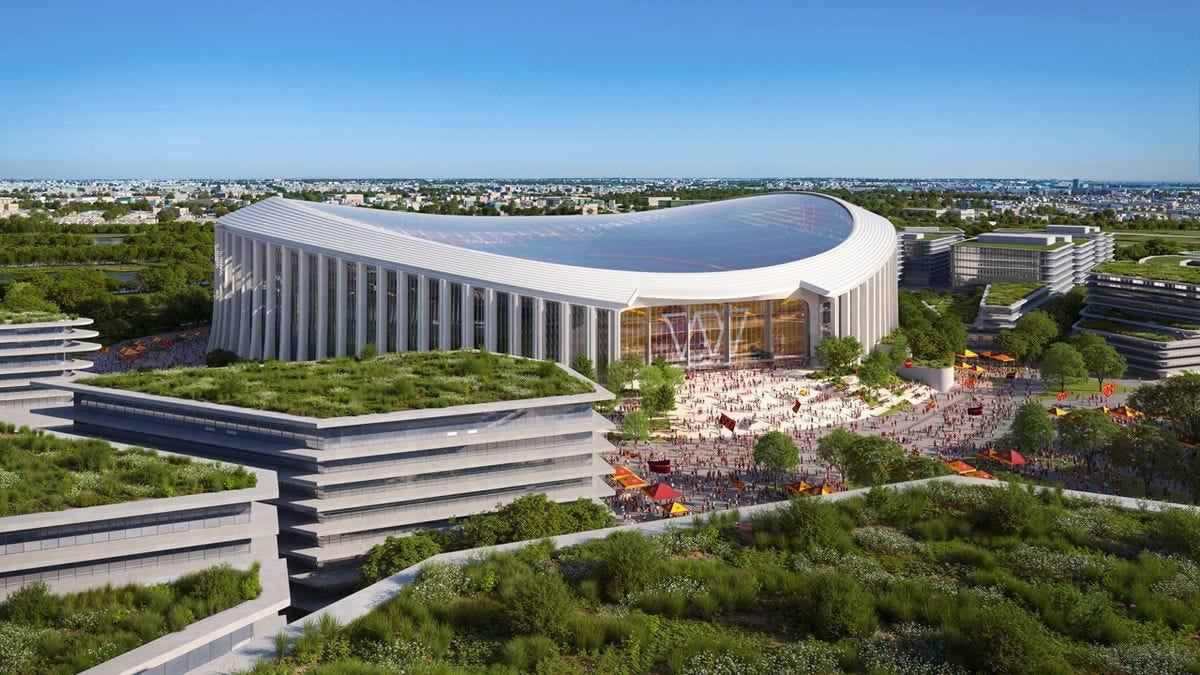
The stadium itself is designed to host more than 200 events annually—not just Commanders games. We’re talking Super Bowls, World Cup matches, major concerts, college football championships, potentially even Olympic events. D.C. currently loses those opportunities to cities with modern, climate-controlled venues. This changes that.
For residents, it means:
∙ A revitalized eastern gateway into Capitol Hill
∙ New housing and commercial development along the Anacostia
∙ Improved Metro capacity and transit infrastructure
∙ Jobs—construction jobs now, permanent jobs once it opens
∙ A reason to be in that neighborhood on a Tuesday in March, not just Sundays in the fall
The Commanders returning to D.C. also restores something intangible: the team playing in the actual capital again, the way it did from 1961 to 1996 when RFK was one of the loudest, most iconic stadiums in football. There’s civic pride wrapped up in that.
What Could Go Wrong
Stadium-driven development projects don’t always deliver. History is littered with examples of publicly financed venues that became albatrosses—beautiful buildings surrounded by empty lots, underperforming retail, and tax revenues that never materialized at projected levels.
The risk here: D.C. is spending over $1 billion on infrastructure, transit, and parking for a facility that might not catalyze the broader development officials promise. What if the housing doesn’t get built? What if the retail spaces sit half-empty? What if the transit improvements aren’t enough and game days still mean traffic nightmares?
Then the District owns an expensive stadium, collects lease payments from the Commanders, and waits decades to recoup its investment—if it ever does.
There’s also the opportunity cost. That $1 billion could have gone toward affordable housing, schools, social services, Metro repairs, or dozens of other priorities. Spending it on a stadium means those needs go unaddressed.
Critics of stadium deals argue that the economic benefits tend to be overstated. People who attend games would have spent that money elsewhere in the region anyway. Jobs created are often part-time and seasonal. Tax revenue projections assume best-case scenarios that rarely play out.
D.C. is banking on this being the exception. Whether that confidence is justified won’t be clear for years.
What It Means for Maryland and Virginia
Maryland loses, unambiguously.
The Commanders have played at what’s now called Northwest Stadium in Landover, Maryland since 1997. Once the team leaves in 2030, that facility becomes a white elephant. Prince George’s County loses game-day economic activity, parking revenue, and the prestige of hosting the region’s NFL franchise.
There’s been talk of repurposing the Landover site, but nothing concrete. Maryland tried to keep the team and failed. Governor Wes Moore even proposed a competing stadium deal, but D.C.’s offer—and federal land access—proved impossible to beat.
Virginia also loses, though less dramatically. The Commanders’ practice facility will remain in Ashburn, so some economic ties continue. But Virginia had been pursuing its own stadium deal to bring the team across the Potomac, and this ends that ambition.
For the broader DMV, the shift centralizes the region’s most prominent sports franchise back in the capital. Whether you see that as fair or as D.C. winning at the expense of the suburbs depends largely on where you live.
The Design: What Fans Can Expect
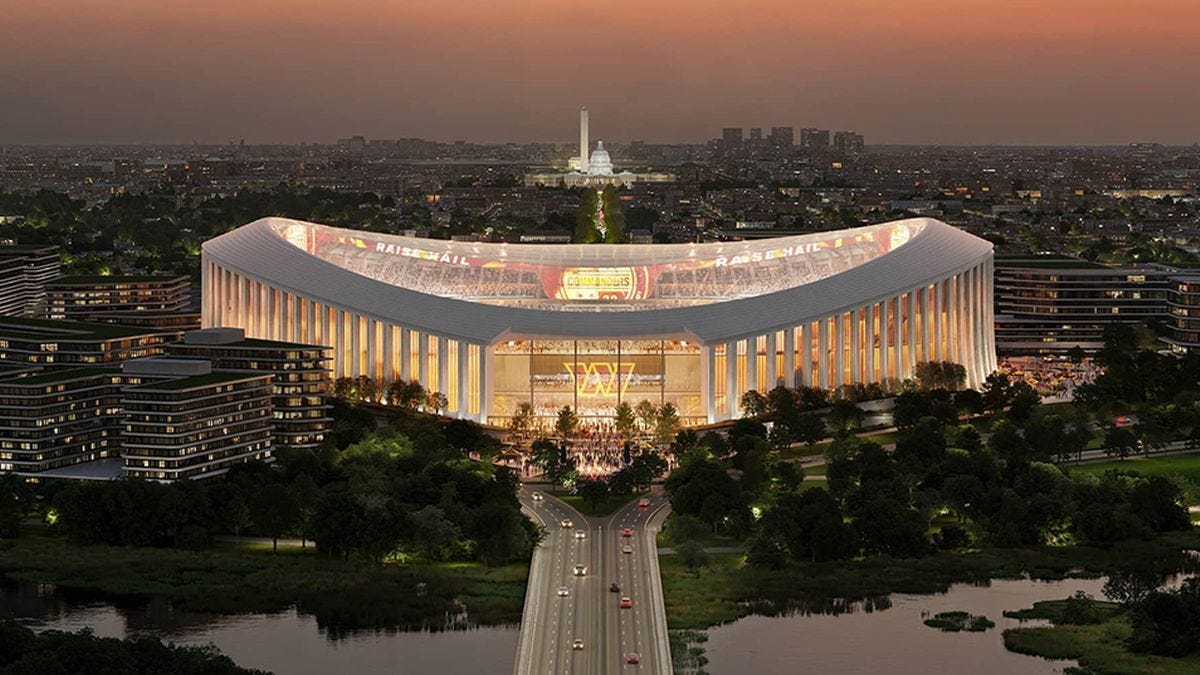
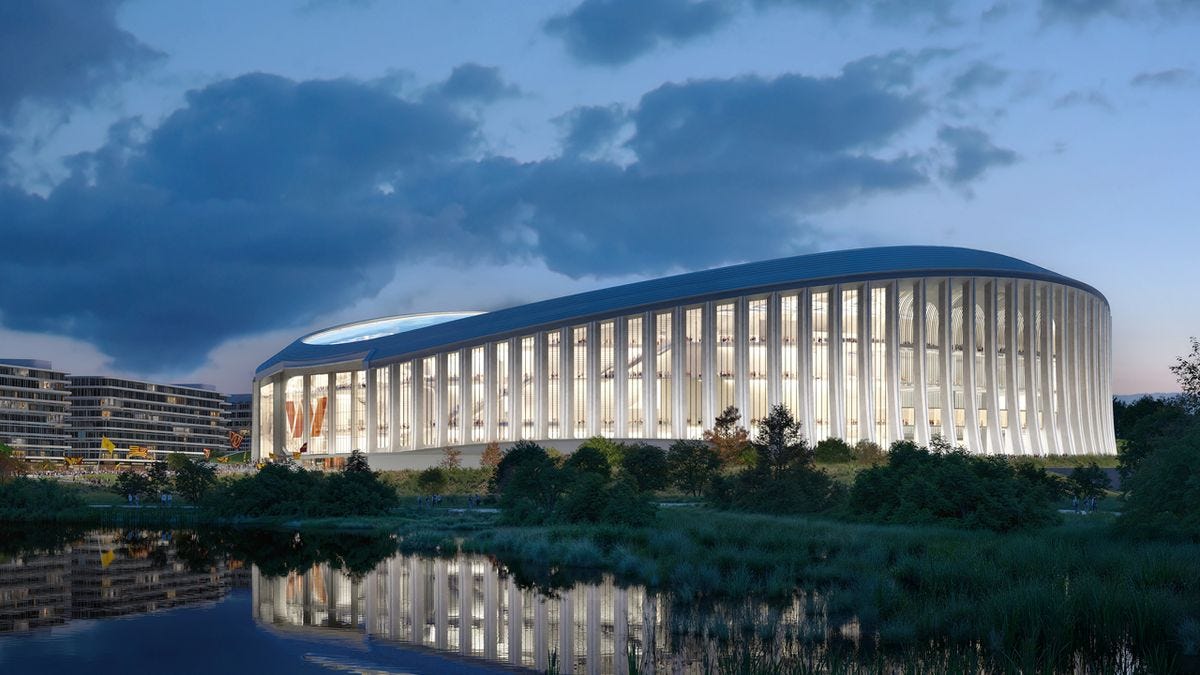
The architecture is deliberately monumental. HKS—the firm behind SoFi Stadium, U.S. Bank Stadium, and AT&T Stadium—designed a structure that aims to fit Washington’s neoclassical aesthetic while delivering modern NFL amenities.
The continuous white colonnade echoes both RFK’s iconic swooping roofline and the grand architecture of the National Mall. The translucent roof allows natural light while providing climate control. The building sits partially embedded into the ground to comply with D.C.‘s strict height restrictions, ensuring it doesn’t compete visually with the Capitol or Washington Monument.
Inside, the design prioritizes what architects call “home-field advantage”—steep seating angles, thoughtful acoustics, and an atmosphere intended to channel the legendary energy of old RFK, where the upper deck would literally bounce during big plays.
But this is a modern facility, which means some traditions die. If you loved RFK’s tailgating—acres of parking lot, grills, coolers, and hours-long pre-game rituals—that’s largely gone. This is an urban, mixed-use development. There will be bars, restaurants, and gathering spaces, but traditional tailgating as Commanders fans knew it won’t exist the same way.
The trade-off: You’ll be able to Metro directly to the stadium, walk from Capitol Hill, Uber from anywhere in the city, and grab dinner before or after the game without sitting in Beltway traffic for 90 minutes each direction.
For some fans, that’s an upgrade. For others, it’s the loss of something irreplaceable.
The Trump Factor: What’s in a Name?
Then there’s the question of what this stadium will actually be called—a topic that’s become unexpectedly political.
Reports emerged late last year that President Trump wants the stadium named after him. The White House has confirmed back-channel communications between the administration and Commanders ownership about the naming. Press Secretary Karoline Leavitt suggested it would be fitting since Trump helped make the deal possible.
That’s partially true. Trump’s administration expedited federal approvals for the land transfer and removed bureaucratic obstacles that had stalled previous efforts. Without that, the deal likely doesn’t happen.
But there’s a complication: Naming rights are typically sold to corporate sponsors for tens of millions of dollars annually. Would the Commanders forgo that revenue to name the stadium after a sitting or former president?
There’s also the question of whether they even have the authority. The stadium will be built on federal land managed by the National Park Service and owned by the District. D.C. Council would likely need to approve any naming decision that doesn’t involve a traditional corporate sponsor. Given the political makeup of the District—which voted overwhelmingly against Trump in both 2020 and 2024—approval seems unlikely.
Prediction markets currently give Trump’s naming ambitions about a 5% chance of success. Most observers expect a traditional corporate deal: FedEx, Capital One, or another major brand writing a check for naming rights.
Still, the fact that it’s even a conversation adds another layer of complexity to an already complicated project.
The Timeline: What Happens When
Groundbreaking is scheduled for 2026. The Commanders will continue playing at Northwest Stadium in Maryland during construction. Completion is targeted for 2030, with the team moving its corporate headquarters to the new stadium district once it opens.
Demolition of the old RFK Stadium—which has sat vacant since 2019—is already underway. The site is being cleared to make way for construction.
Community engagement meetings are ongoing, with the architecture firm and team officials gathering input to refine the design before final approvals. The project still needs to clear reviews by the National Capital Planning Commission, where Trump appointees now hold influence.
Assuming no major delays, the Commanders will play their first game in the new stadium for the 2030 NFL season—33 years after they left RFK and moved to Maryland.
The Bottom Line: High Stakes, Uncertain Payoff
This is the biggest urban development project in D.C. in decades, and the outcome will define the region for a generation.
If it succeeds, the District revitalizes a long-neglected part of the city, brings the Commanders back to their spiritual home, creates thousands of jobs, and establishes a year-round destination that elevates Washington’s cultural and economic footprint. The $1 billion public investment looks visionary in hindsight.
If it fails—if the projected development stalls, if tax revenues fall short, if the neighborhood never takes off—then D.C. has spent a billion dollars on infrastructure for a stadium that mostly benefits a private franchise. Taxpayers are left holding the bag, and critics will point to this as another example of why cities shouldn’t publicly finance sports venues.
The risk is real. The potential is real. The stakes are enormous.
Construction starts in 2026. Doors open in 2030. Four years to build it, and a decade after that to know whether D.C. made a brilliant investment or an expensive mistake.
Either way, the RFK site will never be the same. And neither will the DMV.
—US Daily Letter