


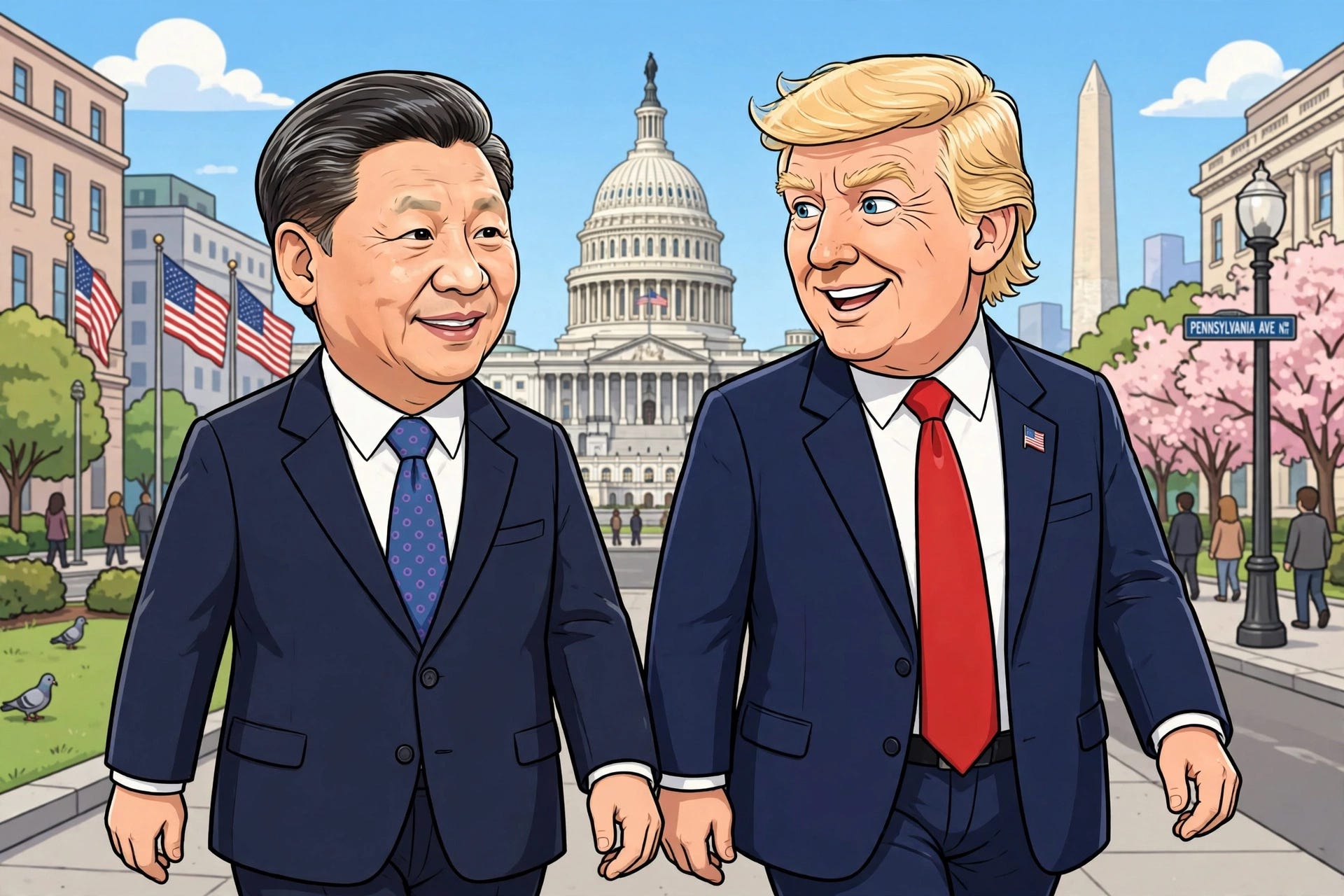
On Wednesday afternoon, a motorcade drove from Joint Base Andrews in Maryland to the White House. Inside one of those vehicles was Xi Jinping, the President of China, the General Secretary of the Chinese Communist Party, the man who governs 1.4 billion people and controls the second largest economy on earth. He had not been to Washington in eleven years.
Trump met him at the airport. That almost never happens. Presidents typically send a designated official to receive foreign heads of state at the tarmac. Trump went himself. The gesture was deliberate and the message was clear before a single word was exchanged: this relationship is different from all the others.
Over the next 48 hours, the two men held formal bilateral talks in the White House, attended a state dinner in the East Room, drank tea together in the Red Room with their wives, and reviewed an honor guard side by side. They met two more times in smaller settings. Trump called it a great meeting. Xi’s foreign minister called it a historic, milestone visit that opened a new chapter in US-China relations.
The analysts who read both official readouts afterward called it something else.
One CSIS assessment described the summit as a nothingburger, double cheesy with extra protocol sauce. The Council on Foreign Relations called it heavy on symbolism but light on substance. CNBC noted that the two countries issued separate statements rather than a joint one, which is itself a signal. When two countries cannot agree on a single shared document after 48 hours of talks, the gap between them is real even when the photographs look warm.
Here is what Americans actually need to know about what just happened in their capital.
What was agreed and what it means
The concrete outcomes of the summit fit on a short list.
The two countries agreed to reduce tariffs on $30 billion worth of goods in each direction. On the American side, that means lower tariffs on small appliances, toys, and decorations coming from China. On the Chinese side, that means lower tariffs on American agricultural goods, wood, and cosmetics going into China. For American farmers and manufacturers in those sectors, that is real and tangible. It is also $30 billion in a trading relationship that runs to more than $600 billion annually. The math tells you how much ground is left to cover.
The existing trade truce, which had been set to expire November 10th, was extended by two months to January 10th. That means tariffs will not snap back to the triple-digit levels of 2025 before the end of the year. American consumers will not see a sudden price shock on Chinese goods heading into the holiday shopping season. That is the good news. The bad news is that extending a truce is not the same as reaching a deal. Every major economic question between the two countries, tariff levels, Chinese purchases of American goods, rare earth supplies, technology restrictions, remains unresolved.
The two countries established a formal AI Dialogue, with the first session scheduled for November. Xi called for stronger management of AI development and keeping AI under human control. Trump emphasized cooperation while maintaining his preference for fewer new AI regulations. That the two most powerful countries in the world now have a formal channel to discuss the most consequential technology of the century is meaningful. What they actually say to each other in November is what will matter.
Fentanyl cooperation was reaffirmed. More flights between the two countries will be added. A trade council and an investment board were established. These are the kinds of outcomes that fill the paragraphs of official communiqués and produce almost no individual headlines.
The three things that did not get resolved
Here is where the visit gets complicated and where American attention should land.
Taiwan. Xi pressed Trump privately to oppose Taiwanese independence and to adhere to what Beijing calls the correct position on Taiwan. Trump did not announce a change in American policy. But the $14 billion in arms sales to Taiwan that Congress approved and the White House has been holding under review since the Beijing summit in May is still being held under review. That decision, when it finally comes, will be the most consequential single action this administration takes regarding China. It did not come this week. Taiwan does not appear in either country’s official readout from the summit. When something that significant is absent from both official statements, it means the two sides could not agree on how to characterize the conversation. That is not progress.
Rare earths. China controls approximately 90 percent of the world’s rare earth processing capacity. These are the materials that go into electric vehicles, semiconductors, fighter jets, and virtually every advanced technology the American economy depends on. Beijing suspended its rare earth export controls earlier this year as part of the trade truce. The suspension runs until January 10th, the same date the trade truce expires. China’s official readout from the summit did not address rare earths at all. The leverage those materials represent did not go away because the two presidents had a pleasant dinner.
Advanced technology. The underlying competition between the United States and China over semiconductors, artificial intelligence infrastructure, and next-generation military technology was not addressed in any substantive public way. The AI Dialogue established this week will discuss risks and benefits. It will not resolve the fundamental question of whether two countries in strategic competition can govern a technology that neither fully controls and both believe will determine the balance of power for the next generation.
The relationship underneath the relationship
This was the second of four planned meetings between Trump and Xi in 2026. Trump went to Beijing in May. Xi came to Washington this week. Trump is scheduled to see Xi again at APEC in China in November. Xi will come to Miami for the G20 in December. Four summits in one year between the leaders of the two most powerful countries on earth is not normal diplomacy. It is something closer to active management of a relationship that both sides believe is too dangerous to leave unmanaged.
That frequency of contact reflects something real. The United States and China are simultaneously the world’s largest trading partners and its most consequential strategic rivals. They compete for technological dominance, for influence in the Pacific, for the loyalty of third countries across Asia, Africa, and Latin America. They are also deeply economically intertwined in ways that make genuine decoupling almost impossible without causing significant harm to both economies.
Xi understands this better than almost anyone in Beijing. He arrived at this summit having watched the Trump administration spend the last year simultaneously fighting a war against Iran, managing a fragile ceasefire in the Middle East, threatening Canada, and dealing with press bans and Supreme Court battles at home. America is stretched. The leverage question between Washington and Beijing is not as simple as it was two years ago, and Xi’s willingness to come to Washington now, on terms that included a state dinner and military honors, reflects a judgment that the relationship is worth tending carefully even when the underlying competition has not been resolved.
Trump understands something different but related. A confrontation with China, on top of everything else this administration is managing, would be politically catastrophic 40 days before the midterms. A summit with photographs of the two presidents drinking tea and reviewing honor guards signals stability. Stability is what markets want and what voters, exhausted by nine months of Iran war and gas prices and economic anxiety, also want. The summit served that function regardless of its substantive outcomes.
What it means for you personally
The tariff reduction on $30 billion in goods means prices on small appliances and certain consumer goods from China may ease modestly before the holidays. Do not expect dramatic price drops. The baseline tariff levels still in place are historically high and the $30 billion covered is a small share of total trade.
The rare earth extension to January means that the advanced technologies embedded in American daily life, from your smartphone to your car’s navigation system, will continue to be produced without a supply shock for the next four months. What happens in January depends on what gets negotiated between now and then.
The AI Dialogue means that the technology most likely to reshape employment, education, healthcare, and national security over the next decade is now at least being discussed between its two most powerful developers at a governmental level. That is better than not discussing it. It is not a governance framework, a safety agreement, or a binding commitment of any kind.
The Taiwan arms sale review, still unresolved, is the one item from this week that could have the most dramatic consequences for ordinary Americans if it goes wrong. Taiwan produces the majority of the world’s most advanced semiconductors. A conflict over Taiwan would disrupt the global supply chain for every piece of technology that matters in modern life within weeks of it starting. The fact that $14 billion in approved arms sales is being held under review, as a gesture toward a country that has consistently said it considers Taiwan a core national interest, is a calculation with enormous stakes attached.
The honest verdict
Xi Jinping came to Washington. He was welcomed at the airport by the president. He ate dinner in the East Room. He drank tea in the Red Room. He pressed on Taiwan. He said almost nothing publicly about rare earths. He agreed to talk about AI in November. He extended a trade truce that was already in place for two more months.
Trump called it a great meeting. The analysts called it a photo-op summit. The Chinese foreign minister called it a new chapter. The CSIS called it a nothingburger with extra protocol sauce.
All of those things can be simultaneously true. Personal diplomacy between leaders of the two most consequential countries on earth has genuine value even when it produces limited deliverables. The alternative to managed tension is unmanaged tension, and unmanaged tension between nuclear-armed economies with competing interests in every corner of the world is considerably more dangerous than a state dinner that changes little on paper.
What this week did not produce was a resolution to any of the fundamental questions that define the US-China relationship. Tariffs, rare earths, Taiwan, technology, the balance of power in the Pacific. Those questions were present in every room Xi and Trump shared this week. They were not answered in any of them.
They will come back. They always do.
Two more summits before the end of the year. APEC in November. G20 in December. The conversation between these two men, and the two countries they represent, is not ending. It is just taking a brief pause for the midterms.
That is what this letter is for.
— US Daily Letter | September 28, 2026