


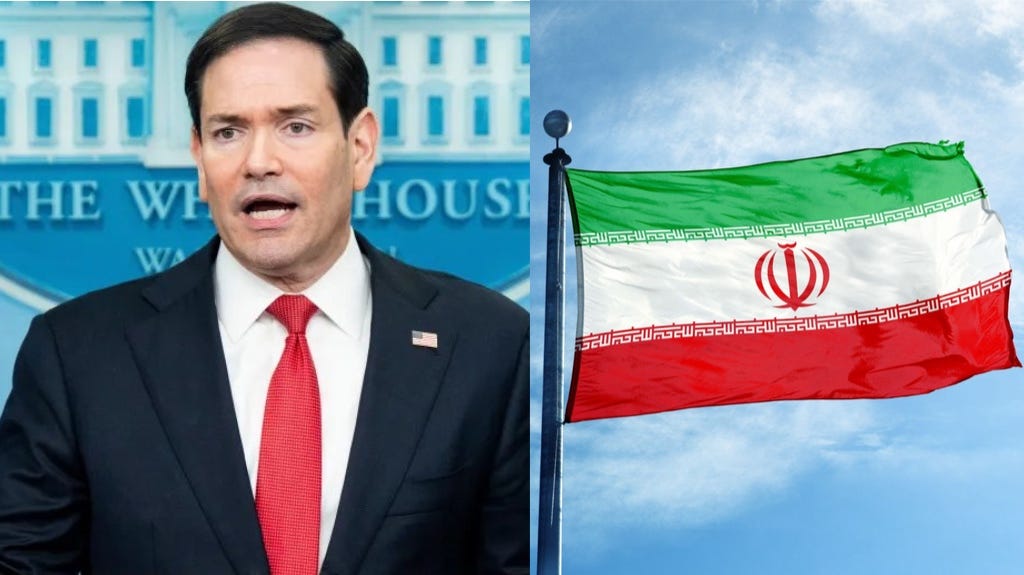
Yesterday morning, Secretary of State Marco Rubio walked up to a podium at the White House and said five words that stopped a lot of people mid-scroll: “The operation is over.”
Operation Epic Fury, the campaign that began on February 28th when American and Israeli forces launched nearly 900 strikes on Iran in a single night, was officially declared complete. Rubio told reporters the mission had achieved its objectives and that Washington now prefers “the path of peace.”
Sixty-seven days. A supreme leader assassinated. A global energy crisis. Gas at $4.45 a gallon. Seventeen countries affected. And now, a press briefing.
Before you exhale, read the rest of the sentence.
On the same day Rubio declared the operation over, Trump posted on social media that Epic Fury would “be at an end” only if Iran “agrees to give what has been agreed to.” Otherwise, he wrote, “the bombing starts, and it will be, sadly, at a much higher level and intensity than it was before.”
So the operation is over. Except it isn’t. Unless it is. Depending on what Iran does next.
That is the honest state of affairs on May 6th, 2026. And you deserve more than a headline.
What Epic Fury actually was
Step back for a second and look at the full picture of what happened over these 67 days, because the official narrative and the actual outcome are two different things.
The United States and Israel launched coordinated strikes on February 28th targeting Iranian military installations, nuclear enrichment facilities, and key officials, including the assassination of Supreme Leader Ali Khamenei in the opening hours.  The operation was called Epic Fury on the American side and Operation Roaring Lion on the Israeli side. It was one of the largest coordinated air campaigns in the history of the modern Middle East.
Iran hit back almost immediately. Under what it called Operation True Promise IV, Iran extended the war’s geographic footprint to seven countries within 48 hours, striking Bahrain, Jordan, Kuwait, Qatar, Saudi Arabia, the UAE, and Iraq. A drone hit a British base on Cyprus. Missiles were shot down over Turkey. The Strait of Hormuz was closed, and the world’s oil supply was functionally held hostage.
This was not a contained operation. This was a regional war.
What the US actually achieved
Here’s where the official story and the military reality diverge, and it matters.
Operation Epic Fury achieved its stated military objectives: degrade Iran’s nuclear program, target senior leadership, and reduce conventional military capacity. The naval blockade produced leverage in ongoing negotiations.  On those narrow terms, Rubio is not wrong to claim success.
But zoom out, and the picture is more complicated. The consensus from the Center for Strategic and International Studies, the Council on Foreign Relations, and the Soufan Centre is that the US achieved tactical damage but could not reach underground infrastructure, could not eliminate the Strait threat, and could not produce the political outcome it sought.
That last part is the part that matters most. Because wars are not ultimately judged by how many targets you hit. They are judged by what changed afterward.
Approximately 50% of Iran’s missile launchers remained intact according to US intelligence assessments in April. The IRGC Navy retained roughly 50% of its pre-war assets. And the regime survived the decapitation of its leadership — succession protocols produced a more hard-line successor drawn entirely from the IRGC.
You killed the general. The army is still standing. And the new general is angrier than the last one.
The Islamabad moment nobody can forget
The clearest measure of where things stand came on April 11th, when JD Vance, Steve Witkoff, and Jared Kushner flew to Pakistan for what was billed as a historic peace negotiation. The US team had 300 members. Iran’s team had 70. They talked for 21 hours across three rounds of negotiations, the highest-level direct engagement between Washington and Tehran since the 1979 Islamic Revolution.
They left with nothing.
“We just could not get to a situation where the Iranians were willing to accept our terms,” Vance told reporters at 6:30 in the morning, boarding his plane home.
Trump’s own summary was stark: “Most points were agreed to, but the only point that really mattered, nuclear, was not.”  Germany’s chancellor said publicly that Iran had “humiliated” US leaders by making them fly to Islamabad and sending them home empty-handed.
The stumbling block was not secret. The US demanded zero uranium enrichment, permanently. Iran’s atomic energy chief replied that his country would not accept limits on its nuclear enrichment program, full stop.  On timeline, the US reportedly asked for a 20-year commitment. Iran offered three to five years. Nobody moved.
Tehran was also demanding control of the Strait of Hormuz, payment of war reparations, a lifting of all sanctions, and a regional ceasefire that explicitly included Lebanon.  Israel said Lebanon was not part of the deal. Iran said there was no deal without Lebanon. The US agreed with Israel.
That is the geometry of a negotiation that was never going to close in one room in Islamabad.
The Strait: still the center of everything
People keep asking what the real issue is. The nuclear program is the headline. The Strait of Hormuz is the body of the story.
By March, only 154 vessels passed through the Strait. In a normal month before the war, it was closer to 3,000. That single number explains why gas costs $4.45 a gallon in New York. Why airlines are folding. Why shipping companies are rerouting through the Cape of Good Hope and adding three weeks to their delivery times. Why inflation is ticking back up in places that thought they were done with it.
Iran’s parliament is now moving to pass a law formally codifying restrictions on who can use the Strait, stating that Israeli vessels will never be allowed through and that ships from “hostile countries” will be required to pay reparations for a permit.  That is not a negotiating position. That is a legal architecture being built around permanent leverage.
Trump responded by launching Project Freedom on Monday, a US military escort mission through the Strait involving guided-missile destroyers, more than 100 aircraft, and 15,000 service members. By Tuesday he had paused it. Experts say the pause of Project Freedom could be the beginning of the end for the war on Iran, a signal that Washington is genuinely looking for an exit.
Or it could be a 48-hour tactical pause before everything escalates again. We have been in this film before.
What it all actually means
Let’s be honest about something most commentators won’t say plainly. The United States went into this conflict with three goals that were never fully compatible with each other: destroy Iran’s nuclear capability, produce regime change, and keep the Strait open. It achieved partial versions of two out of three and is still negotiating the third.
The post-1945 model of alliance burden-sharing depends on consultation, reciprocity, and shared ownership of risk. Operation Epic Fury inverted that sequence, initiating conflict first and seeking coalition support afterward. The result is not simply friction, but a weakening of the alliance model itself.  America’s NATO partners were not consulted before the strikes. Germany and France found out when the bombs were already falling. That is a relationship damage that will not be repaired with a White House press briefing.
At home, only 32% of Americans surveyed say they support the war. Trump himself acknowledged that number this week, calling the polls “fake” but notably not disputing that his approval on this specific conflict is underwater.
And then there is the question that nobody in Washington wants to answer out loud: if the goal was to prevent Iran from getting a nuclear weapon, and Iran still has 50% of its missile infrastructure intact, a harder-line IRGC leadership running the country, and a deep motivation to accelerate its nuclear program as a deterrent against future strikes, then what exactly was accomplished?
Military analysts put it this way: there was a failure to connect military action to a political end-state. The institutional processes that exist to ensure that connection were not used.  That is a polite way of saying the strategy was built backward, with the bombing decided before the endgame was defined.
What comes next
A second round of talks in Islamabad is being discussed. Pakistan has kept the channel open and deserves credit for that. Iran has sent signals through mediators that it is willing to keep talking. Trump extended the ceasefire once already and may do so again.
The most honest scenario is this: the war as a full-scale air campaign is probably over. The conditions that caused it, the nuclear standoff, the Strait as a weapon, the proxy conflicts from Lebanon to Iraq to Yemen, are not. They have been scrambled, not resolved. And the new Iranian leadership, drawn entirely from the hardest line of the Revolutionary Guard, has no political incentive to appear to have capitulated to American bombs.
The deal that eventually gets made, if one gets made, will likely look a lot like what was on the table in February, before any of this started. That is what makes the last 67 days so painful to reckon with.
A lot of people died to end up back at the table.
That’s what this letter is for. To tell you the truth, even when it’s uncomfortable.
— US Daily Letter | May 6, 2026