


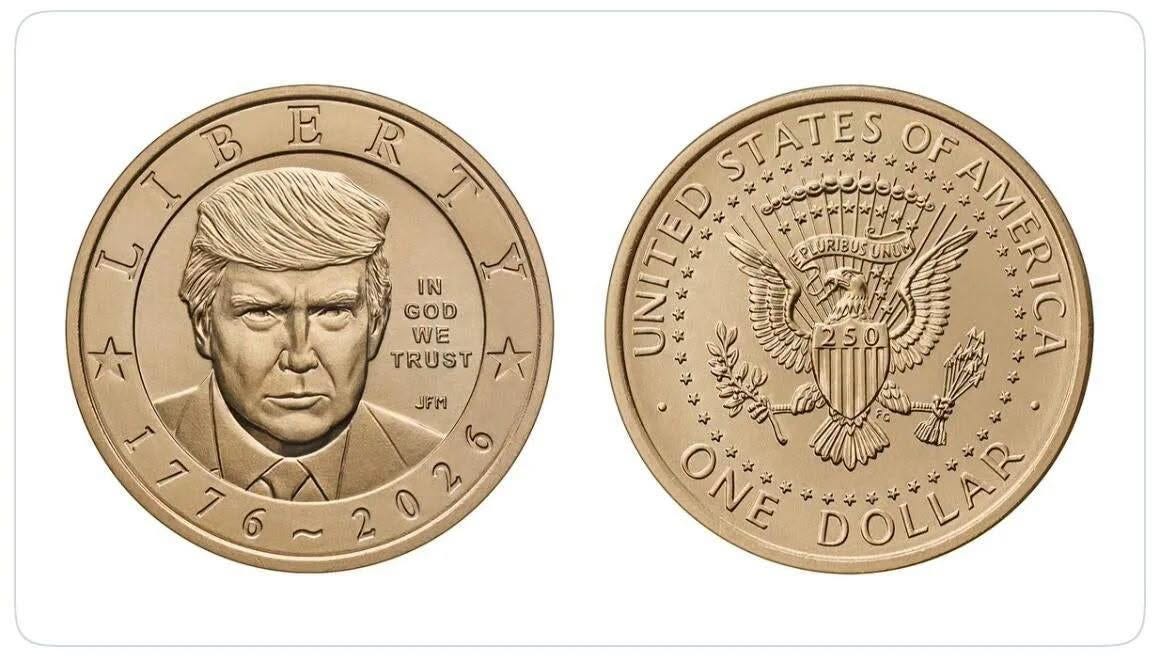
This week, the United States Mint began producing a new dollar coin. On the front: Donald Trump, in a suit and tie, with a stern look on his face. Around him, the word LIBERTY arcs across the top. The dates 1776 and 2026 frame the bottom. IN GOD WE TRUST sits in the middle.
The coin is gold. Or rather, it looks gold. It is not made of gold. It is composed of non-precious metals with a gold-like finish on the exterior, which is a technically accurate description that also tells you almost everything you need to know about the aesthetic ambitions of this project.
Trump, when asked about it Wednesday on Fox Business Network, said: “It’s very unusual, but I was honored by it. It’s very cute they gave me a coin.”
There is a law that says this coin should not exist. The coin exists anyway. That tension, between the legal, the historical, and the political, is worth unpacking carefully before everyone retreats to their corners and starts yelling.
What the law actually says
Federal law has prohibited the depiction of a living person on United States currency since 1866. The prohibition came after Congress got fed up with Treasury Secretary Salmon Chase putting his own face on paper money during the Civil War and decided the practice was unseemly enough to ban permanently. For 160 years, the rule held. Washington on the quarter. Lincoln on the penny. Hamilton on the ten. Every face on American money belonged to someone already dead.
The Trump coin exists because of a carve-out. In 2020, during Trump’s first term, Congress passed a law authorizing commemorative dollar coins in 2026 with designs, in the law’s exact language, emblematic of the United States semiquincentennial. That law gave the Treasury Secretary the authority to authorize the minting and issuance of coins in connection with the 250th anniversary celebration.
Treasury Secretary Scott Bessent used that authority. He argued the design falls squarely within the America 250 statutory authority and called the coin a way to honor both our founding and our current leadership within the bounds Congress has set. The Commission of Fine Arts, whose members were appointed by Trump, approved the design earlier this year.
What the law authorized was a semiquincentennial coin. What the Treasury produced was a Trump coin with semiquincentennial dates on it. Whether those two things are the same depends entirely on who you ask and what you believe about the people making the decision.
What is on the coin and what changed
The front features Trump in a suit and tie with a stern expression, which is not how most commemorative coins tend to present their subjects, but is consistent with the particular brand of stern authority Trump has cultivated across two decades of public life. The word LIBERTY arcs across the top. The dates 1776 and 2026 sit at the bottom. IN GOD WE TRUST appears in the center.
The back is traditional: the bald eagle from the Great Seal, UNITED STATES OF AMERICA across the top, E PLURIBUS UNUM on the shield across the bird’s breast.
An earlier version of the design, approved by the Commission of Fine Arts in the spring, showed Trump with his fists resting on a desk as he leaned forward. That version did not make it to production. The Treasury Department has not explained why the final coin differs from the approved design, or who made that call, or when. The fists are gone. The stern look remains.
The coin will not circulate as regular currency. It will be sold through the US Mint’s numismatic channels as a packaged legal-tender dollar, meaning you can spend it as a dollar but you would not receive it as change at a grocery store. It carries a modest premium over face value. It is, in the language of coin collecting, a commemorative piece aimed at collectors and, presumably, supporters.
The context that matters
This coin does not exist in isolation. It is the latest entry in a pattern that has been building since Trump’s second inauguration.
In March, the Treasury announced that Trump’s signature would appear on all new US paper currency. Traditionally, bills carry the signatures of the Treasury Secretary and the Treasurer of the United States, not the president. That change means that every dollar bill printed from this point forward carries Donald Trump’s name on it, a departure from 230 years of practice.
Trump has also renamed the US Institute of Peace, the Kennedy Center, a new class of US Navy battleships, and multiple federal buildings after himself or members of his family. His name appears on the checks sent to families through the Trump Accounts program. The dollar coin announced Wednesday is not an isolated gesture. It is part of a coherent and deliberate project of imprinting a presidency onto the physical artifacts of American life.
In a 2025 letter to Bessent, Senate critics warned that putting Trump on a dollar coin risked edging the United States toward a cult of personality aesthetic more common in monarchies and urged Treasury to stick with non-presidential semiquincentennial motifs. The letter did not stop the coin. It did produce a useful phrase that will be debated for years.
The two honest arguments
Here is where this letter tries to do something the cable news coverage will not.
The case for the coin, made honestly: Congress passed a law in 2020 authorizing commemorative semiquincentennial dollar coins. The Treasury Secretary has statutory authority to approve coin designs in connection with that anniversary. Every face on American currency represents a human being who once led this country. The 250th birthday of the United States is a genuine occasion for commemoration. A president who presided over the anniversary year appearing on a commemorative coin is not, on its face, historically unprecedented in concept even if it is unprecedented in the specific.
The case against it, made equally honestly: the 1866 prohibition on living persons on currency exists for a reason that has not changed. The Commission of Fine Arts that approved the design was appointed by the man whose face is on the coin, which is not an independent review process by any reasonable definition. The coin is not a neutral historical document. It is being released during an active presidency, by a Treasury Secretary who serves at the pleasure of the man depicted, in the context of a broader pattern of putting that man’s name and face on as many public artifacts as possible. The semiquincentennial law authorized a coin emblematic of the nation’s 250 years. A portrait of the sitting president is a portrait of the sitting president. Those two things are not identical.
Both of those arguments are real. Both deserve to be heard before anyone decides which one wins.
The bottom line
By this fall, you will be able to walk into a post office or log onto the US Mint’s website and purchase a gold-toned dollar coin bearing the face of a living president, the first time that has happened in American history under a law designed to prohibit exactly that, enabled by a statutory carve-out, approved by a commission the president himself appointed, announced by a Treasury Secretary who serves at his pleasure.
Trump called it very cute. Critics are calling it something else entirely. The coin presses at the Philadelphia Mint are already running.
Whatever you think about the politics, the precedent is set. The next president will be able to point to this moment and say it has already been done. The one after that. And the one after that.
That is the thing about precedents. They are very hard to unmint.
That is what this letter is for.
— US Daily Letter | July 16, 2026