


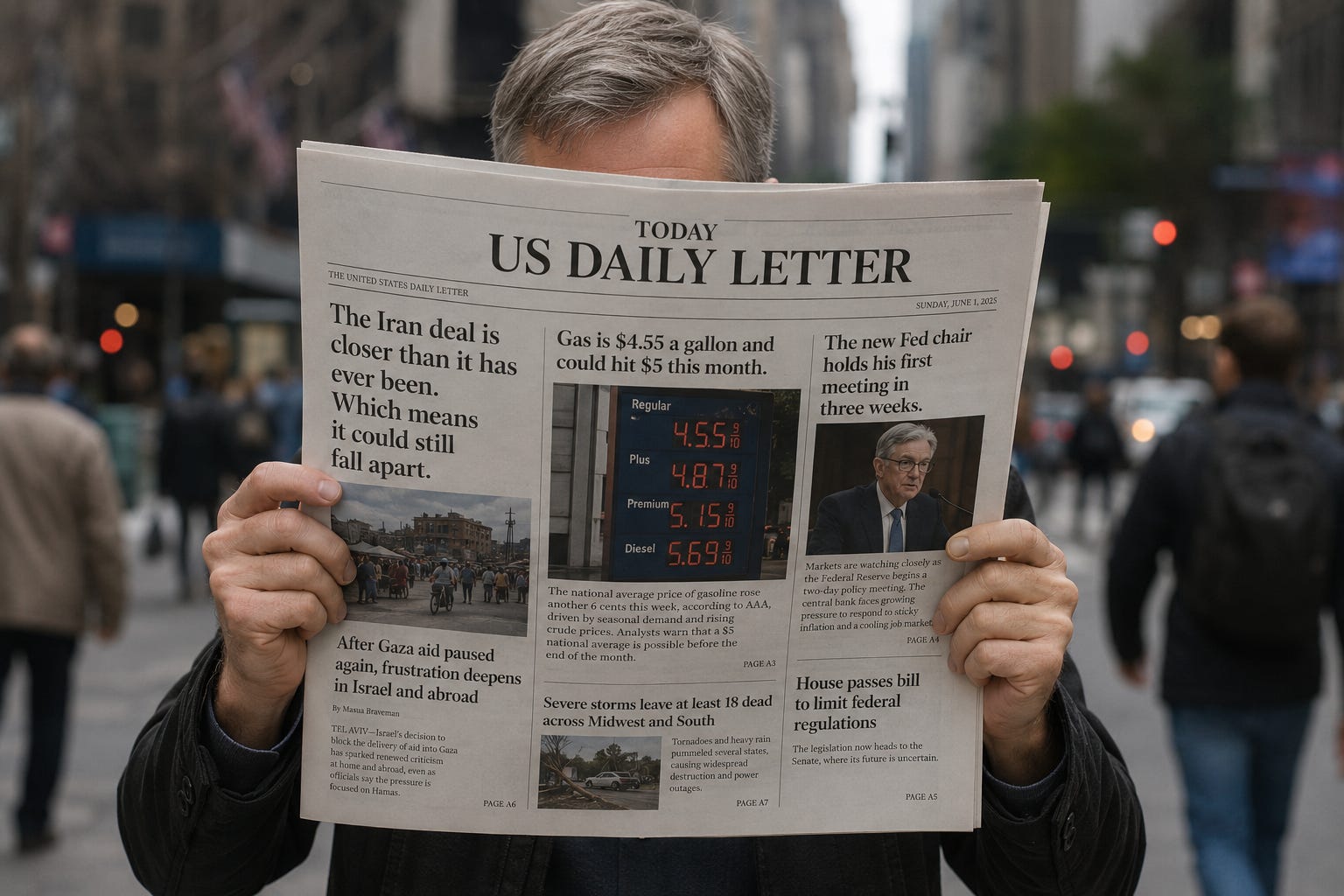
A letter from US Daily Letter HQ. Monday, June 1st, 2026.
Welcome to June. The world did not slow down for the calendar change. Here are the ten things worth knowing as this week begins.
1. The Iran deal is closer than it has ever been. Which means it could still fall apart.
Secretary of State Marco Rubio said Friday that US-Iran negotiators have agreed to broad principles of an agreement, conveyed through Pakistani mediators, and that there has been “a little bit of movement.” Tehran confirmed it is considering the latest American proposal. That is genuinely the closest thing to progress this conflict has produced since Islamabad failed in April. The nuclear question is still the wall. Nothing is signed. Nothing is guaranteed. But pay attention to whatever comes out of the next 72 hours.
2. The Strait of Hormuz has been closed for 92 days.
Iran has blocked or threatened shipping through the Strait since February 28th, laying sea mines, boarding merchant vessels, and warning all foreign ships that passage is prohibited. Seventeen merchant ships have been damaged, seven abandoned, and twelve seafarers killed or missing. The world’s most important energy chokepoint is now in its fourth month of crisis. Every day it stays closed, the damage compounds.
3. Hurricane season starts today. And the agency watching it has been defunded.
NOAA officially opens the 2026 Atlantic hurricane season today, forecasting a below-normal season with 8 to 14 named storms, including 3 to 6 hurricanes and 1 to 3 major hurricanes. The relatively calm forecast is the good news. The bad news: the Trump administration proposed cutting NOAA’s budget by more than a quarter, including dismantling its Office of Oceanic and Atmospheric Research. Even after Congress rejected the deepest cuts, NOAA’s budget is still down from previous years and staffing is stretched. A below-normal forecast still means storms. Storms still need people watching them. The agency doing the watching has fewer people than it did last year.
4. Gas is $4.55 a gallon and could hit $5 this month.
The Memorial Day number was already the highest since 2022. Analysts are warning that global oil inventories have roughly four to six weeks before the cushioning effect runs out entirely. If the Iran deal does not produce a Strait reopening soon, the summer driving season is going to get considerably more expensive before it gets better.
5. London just had its hottest May in recorded history. Europe is not fine.
The UK recorded its hottest May day ever twice in the same week, hitting 95.2 degrees Fahrenheit in London. At least nine people died in water-related incidents, including seven children. A wildfire broke out near Edinburgh. Only 5 percent of UK homes have air conditioning. The heatwave is moving into early June. This is not a European story. It is a preview of what extreme heat does to countries that were not built for it, and the United States has plenty of its own infrastructure not built for what is coming.
6. America has been bombing boats in the Pacific for nine months. 200 people are dead.
Operation Southern Spear, the US military campaign against suspected drug traffickers in the Eastern Pacific and Caribbean, has now carried out more than 50 strikes killing nearly 200 people since September 2025. Ecuadorian fishermen are coming forward saying their boats were among those destroyed. The Trump administration says the operations are legal but has not publicly identified any of the victims or provided evidence about individual strikes. This story is underreported and it deserves your attention.
7. Israel is still bombing Lebanon. Every single day.
While Iran dominates the headlines, the IDF carried out over 120 airstrikes across southern and eastern Lebanon last week alone, killing dozens of civilians. Netanyahu has threatened to escalate toward Beirut. Iran has made any peace deal with the US contingent on a Lebanon ceasefire. Israel says Lebanon is not part of any Iran deal. That disagreement is one of the main reasons the broader conflict will not close cleanly even if the nuclear question somehow gets resolved.
8. The new Fed chair holds his first meeting in three weeks.
Kevin Warsh was sworn in last Friday as Federal Reserve Chair with Trump standing next to him predicting rate cuts “very quickly.” Markets are betting there will be no cuts this year. Warsh is a hawk with his own agenda and has publicly stated he would never commit to a rate decision in advance. His first FOMC meeting is June 17th. Whatever he decides will affect your mortgage, your savings account, and the cost of borrowing for every business in America.
9. The Big Beautiful Bill is coming to a vote.
Trump’s sweeping domestic legislative package, which combines tax cuts, spending reductions, and significant changes to Medicaid and student loan programs, is heading toward a congressional vote this week. It has divided Republicans in the House, drawn fierce opposition from Democrats, and is being described by some fiscal analysts as the largest single piece of deficit-expanding legislation in American history. Watch the vote count carefully. This one has real consequences for real people.
10. The world is tired. But it cannot afford to look away.
Ninety-two days of war. A heatwave across Europe. A hurricane season starting with a defunded weather agency. Gas at $4.55. A Fed chair facing his first real test. Military strikes in the Pacific nobody is talking about. A Lebanon conflict running parallel to a bigger one. It is a lot to carry into a Monday morning. But this is the world as it actually is right now, and knowing it is the first step toward navigating it.
We will be here all week.
That is what this letter is for.
— US Daily Letter | June 1, 2026