


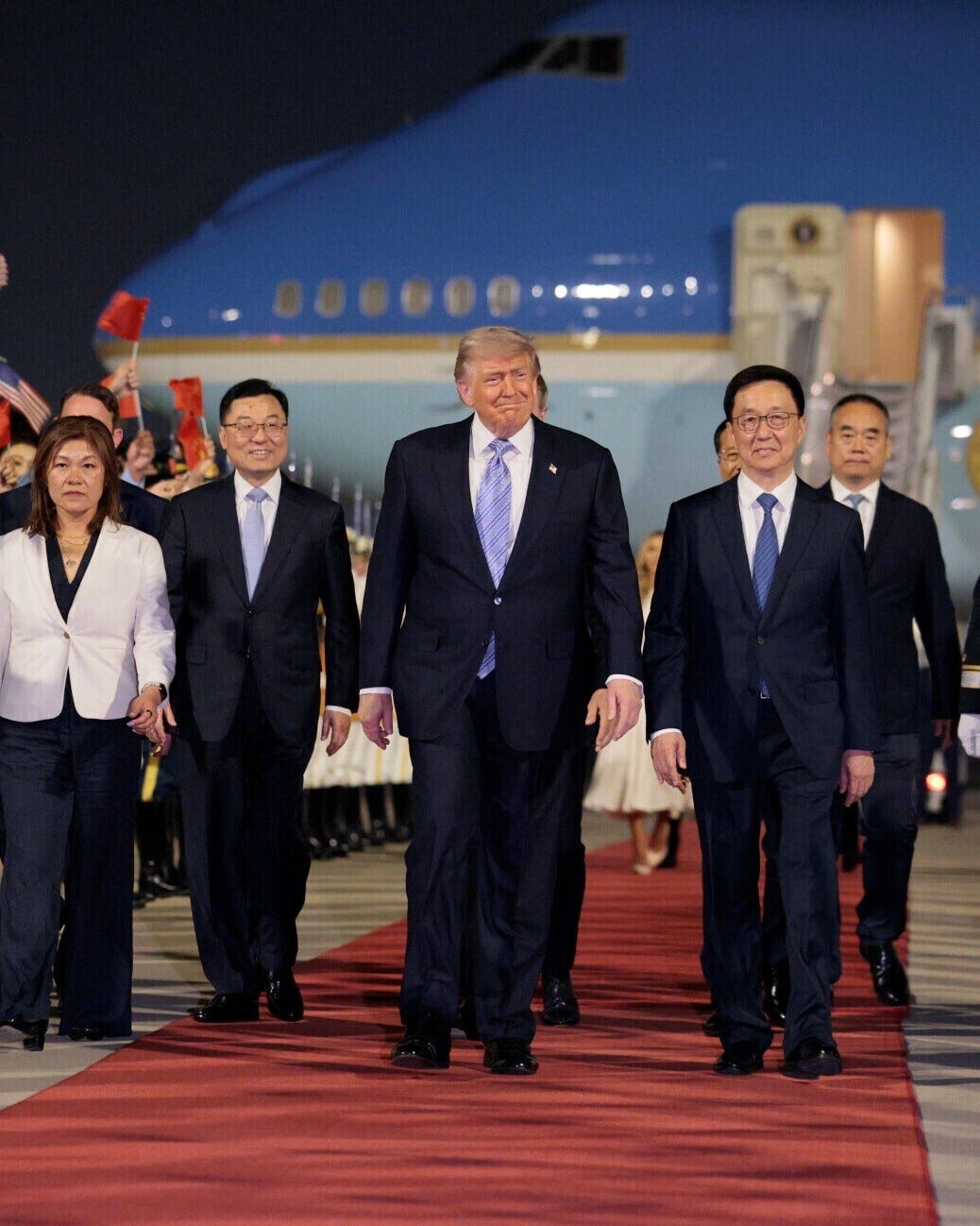
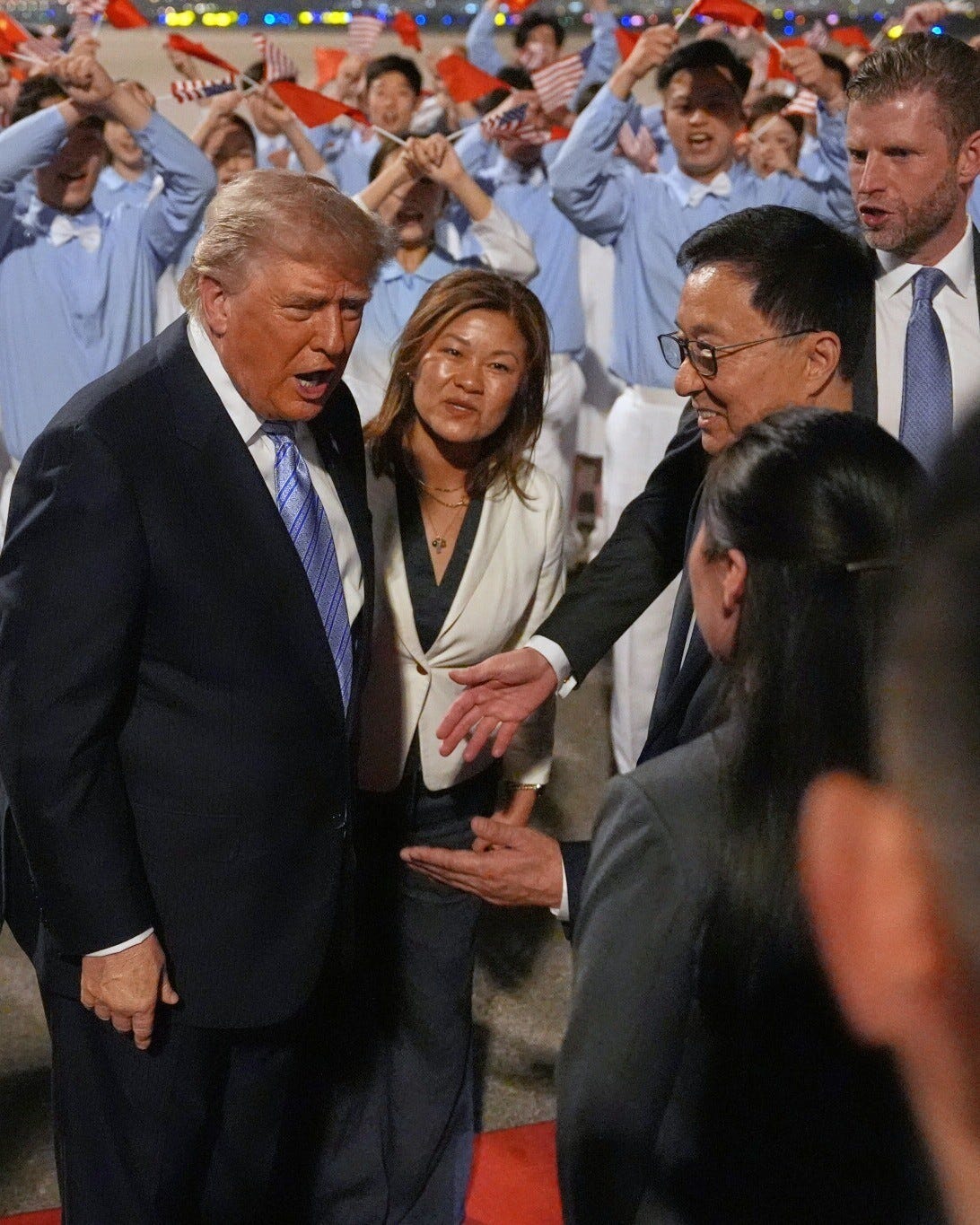
This morning, Air Force One touched down at Beijing Capital International Airport. Three hundred Chinese children in blue and white uniforms lined the tarmac waving American and Chinese flags. A brass band played. Chinese Vice President Han Zheng, Xi Jinping’s chosen envoy for diplomatic ceremonies, walked out to greet the president. Elon Musk, standing nearby, shook the vice president’s hand.
It was the first time an American president had set foot on Chinese soil in nearly nine years. The last time was November 2017, also Trump, also Xi, also with pomp and pageantry and a tour of the Forbidden City. A lot has changed since then. The two countries have fought a trade war. American companies have been pushed out of Chinese markets. China has built military infrastructure across the South China Sea. The United States has spent the last 73 days bombing China’s closest energy partner in the Middle East while simultaneously asking Beijing to help clean up the mess.
Kurt Campbell, a top Biden-era China adviser, put it plainly: “It is remarkable that President Trump is prepared to go to China under these circumstances. But may I also say that it is also deeply unusual that China is prepared to host him.”
That sentence contains the whole story of this visit. Both sides need something. Neither side wants to appear to need it. And the outcome of the next 48 hours will affect the price of your gas, the future of Taiwan, the technology in your next phone, and the shape of a global order that is being renegotiated in real time behind closed doors in Beijing.
Here is what every American should actually know.
Why this visit happened at all
The Beijing summit was originally planned for April but was postponed when the Iran war started on February 28th. The delay was telling. Washington was bombing China’s closest ally in the Middle East and simultaneously trying to arrange a state visit with the country that buys more Iranian oil than anyone else on earth. The diplomatic gymnastics required to hold both positions at once were extraordinary.
And yet here we are. China’s goal, according to analysts at Trivium China, is to put the relationship on a stabler, longer-lasting footing after the constant turbulence of 2025. Anything beyond that will be a bonus.  That is a modest ambition for a summit this large, but modesty is the only realistic option when the agenda includes trade, Taiwan, artificial intelligence, a shooting war in the Middle East, and the world’s most critical energy chokepoint.
Trump told reporters before departure he expected “great things” from the summit. Experts expected something considerably more measured.
The Iran question that dominates everything
Trump said publicly that trade would be the main focus of the trip. Then he said he would have “a long talk” with Xi about Iran. Both things are true, but only one of them is urgent.
Analysts have been blunt about what Washington actually needs from Beijing: China purchases more than 80 percent of Iran’s shipped crude exports. It is, by a wide margin, the largest buyer of Iranian oil on earth. If Xi were to apply meaningful pressure on Tehran, to tell Iran privately that China’s support has limits and that reopening the Strait is a condition of continued partnership, the entire dynamic of the Iran negotiation could shift.
Lyle Goldstein, director of the China Initiative at Brown University, said he could imagine Trump asking Xi directly to pressure Iran to reopen the Strait of Hormuz and return to the negotiating table. “Let’s face it,” Goldstein said, “this war will dominate the summit. It will push a lot of other things off the agenda.”
The complication is that China has every reason to stay neutral and several reasons to prefer the war continues at its current low simmer. In the lead-up to the summit, China ordered its companies not to comply with US sanctions on Iranian oil and hosted Iran’s foreign minister for a visit in Beijing. Those are not the gestures of a country preparing to break with Tehran. They are the gestures of a country that understands its own leverage and is not in a hurry to spend it.
The ordinary residents of Beijing that CNN spoke to along the streets near the Second Ring Road voiced little appetite for China becoming more involved to end the Iran war. Their views reflected a broader instinct: frustration with Washington, exhaustion with geopolitical confrontation, and a strong preference for neutrality.
Xi does not govern by public opinion the way Trump does. But those streets matter as context. Beijing is not arriving at this summit in a mood to do America any favors.
The Taiwan card nobody wants to talk about
Here is the conversation that could blow up everything else in the room.
On May 11th, Trump announced he would raise with Xi the matter of arms sales to Taiwan, breaking with the Six Assurances, the longstanding US framework that had governed American arms sales to the island since 1982. That is a significant departure. The Six Assurances were designed precisely to prevent American presidents from using Taiwan as a bargaining chip with Beijing. Trump is apparently prepared to use Taiwan as a bargaining chip with Beijing.
Some US officials have expressed concern that Trump is walking into a meeting where Xi holds the cards, and that the Chinese leader may use that leverage to get what he wants on Taiwan. Trump himself told reporters Monday: “He’ll bring up Taiwan, I think, more than I will.”
That casual remark conceals an enormous amount. Experts noted that the ongoing Iran war has given China greater leverage generally, because the US has diverted significant military resources away from South Korea and Japan to the Middle East, reducing American capacity to respond to a potential conflict over Taiwan. Xi knows this. Trump knows Xi knows this. And the question of what gets traded across that table in exchange for Chinese cooperation on Iran is one that the 23 million people of Taiwan are watching with considerable anxiety.
The business delegation and what it signals
Trump brought with him to Beijing a delegation of executives representing some of America’s most valuable companies, including Elon Musk of Tesla and Jensen Huang of Nvidia. Also present were the CEOs of Boeing and Mastercard.
This is not incidental. It is the message. Trump is telling Xi, and the world, that this visit is as much about commerce as it is about conflict. Analysts anticipate that Trump and Xi may announce large Chinese orders of American planes and soybeans when the meetings conclude. Boeing desperately needs orders. American agriculture desperately needs export markets. And Trump needs a win he can point to before he boards Air Force One on Friday and flies home to a country where gas is still above $4 a gallon and the Iran ceasefire is still on life support.
The presence of Eric Trump and Lara Trump on the trip, accompanying the president “in a personal capacity” as representatives of the Trump Organization’s business interests, has already drawn conflict-of-interest questions from ethics watchdogs. The Trump Organization is a private business. Its principals are meeting with Chinese officials in Beijing while the president of the United States is negotiating trade and security terms in the next room. That is worth noting, even if nobody in the administration thinks it warrants a second look.
What Xi actually wants
This is the question that American coverage tends to underweight, and it is the most important one.
Xi arrives at this summit having achieved something he has wanted for years: being received as an equal by the United States. The last year of tit-for-tat tariffs, China’s willingness to leverage its hold over rare earth supply chains, and now Trump flying to Beijing to ask for help with Iran have all reinforced a single message that Xi has been sending since 2013: China is not a junior partner. It is a co-equal power that expects to be treated as one.
As one analyst at Leiden University put it: “Trade remains politically powerful, especially for Trump, because it gives rivalry a language that voters can easily understand. Yet the deeper conflict concerns hierarchy, legitimacy, and the future architecture of global order.”
That is what is actually being negotiated in Beijing this week. Not just soybeans and planes and whether Iran reopens the Strait. The shape of who runs the world for the next generation.
What to watch before Friday
The formal meetings between Trump and Xi begin Thursday morning Beijing time, which is Wednesday evening for most Americans. After the bilateral session, the two leaders are scheduled to tour the historic Temple of Heaven together and attend a state banquet. On Friday, they will share tea and a working lunch before Trump departs.
Watch for four things when the readouts start coming.
First, whether China commits to anything specific on Iran, or offers only vague language about de-escalation and dialogue. Specific commitments would be a genuine win for Trump. Vague language would mean Xi gave up nothing.
Second, whether Taiwan appears in any joint statement and in what terms. Any language that softens America’s longstanding position on Taiwanese sovereignty would be alarming and consequential.
Third, what deals get announced and who benefits. Boeing orders are good for American workers. But if rare earth supply restrictions get quietly eased in exchange for American concessions elsewhere, the headline deal may obscure the real cost.
Fourth, whether Trump boards Air Force One on Friday claiming a “12 out of 10” the way he described his last meeting with Xi in South Korea. After that Busan summit last fall, Trump said on Air Force One: “From zero to 10 with 10 being the best, I would say the meeting was a 12.” If he uses that language again, it likely means the deliverables were thin and the atmospherics were all anyone has to show for it.
The bottom line
The most powerful man in the world is sitting in Beijing right now, in a city that is watching him with wariness, asking the leader of the country that is simultaneously his largest trading partner, his primary strategic rival, and his closest ally’s largest oil customer to help him end a war he started.
That sentence should give every American pause, regardless of politics.
The Iran ceasefire is on life support. The Strait of Hormuz is still contested. Gas is still expensive. Taiwan is still on the table. And somewhere in Beijing tonight, in a room full of interpreters and aides and the weight of history, two men are deciding how much of all of that changes before Friday.
We will be watching every word that comes out of those rooms. And we will write you the moment the smoke clears.
That is what this letter is for.
— US Daily Letter | May 13, 2026