


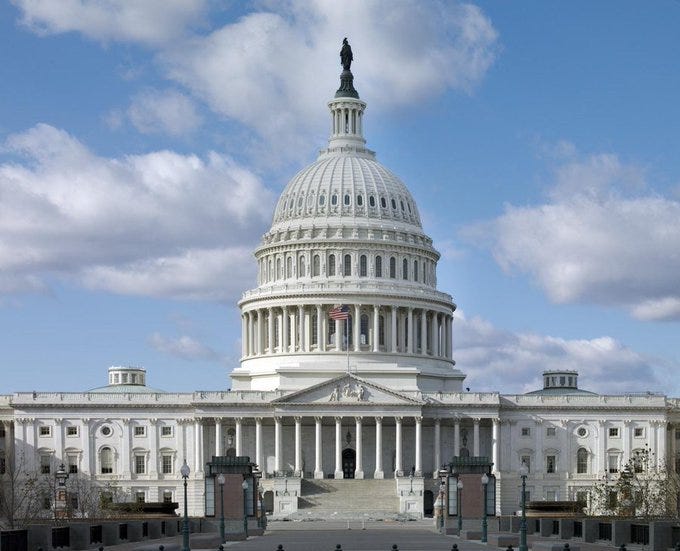
LETTER FROM CONGRESS
What happened on Capitol Hill this week — and what it means for the rest of the country
June 5, 2026
This was not a normal week in Washington. It rarely is anymore. But this week, something genuinely significant happened inside the United States Congress, something that has not happened since the Vietnam era, and most Americans woke up this morning not fully aware of it.
On Wednesday, the House of Representatives voted to end the war with Iran.
Let that land for a second.
A bipartisan majority in the Republican-led House voted 215 to 208 to pass a war powers resolution directing President Trump to end hostilities with Iran, with four Republicans joining Democrats in support. It was the clearest congressional rebuke of the president’s conduct of this war since the bombs fell on February 28th. It was not loud. It did not make the front page the way a missile strike does. But it happened, and it matters.
Here is the full picture of what Congress did and did not do this week.
The war powers vote, what it means and what it does not
Start with the honest caveat: the resolution is mostly symbolic. Democrats have been unable to pass a matching measure in the Senate, and even if they could, Trump would almost certainly veto it. The White House dismissed it within the hour. Trump called it a disgrace. Republican leadership in the Senate said it would go nowhere.
But dismiss it as symbolic at your peril. Four House Republicans broke with their party and their president to vote that this war should end. That number does not sound large. In a chamber where the Republican majority is razor-thin, it is enormous. Republicans had actually called off an earlier scheduled vote in May when it became clear they did not have the numbers to defeat the resolution. They delayed it into June hoping to shore up support. They could not.
This is a war that started without a vote of Congress. The House and Senate have collectively rejected nine war powers measures since early March. The Pentagon testified this week that the conflict has cost $25 billion so far, not counting damage to US military installations, and that a supplemental appropriations request, meaning a bill to pay for the war retroactively, will come to Congress once costs are fully assessed.
Nobody voted to start this war. Now Congress is being asked to pay for it after the fact. And four Republicans decided this week they have had enough.
Hegseth on the hot seat
Defense Secretary Pete Hegseth appeared before the House Armed Services Committee this week for his first congressional testimony since the war began. The hearing was ostensibly about the administration’s 2027 military budget, which would boost defense spending to a historic $1.5 trillion. What it became was a reckoning. 
Democrats pressed Hegseth on the cost, the legal authority, and the strategy. He called congressional Democrats and some Republicans the administration’s “biggest adversary” in the war, a statement that drew gasps in the chamber and confirmed what many members had suspected: the Pentagon views Capitol Hill oversight not as a constitutional function but as an obstacle.
Republicans focused on the budget numbers and largely voiced support for the operation. But even GOP members signaled they are eager for the conflict to end, and several are privately watching the war powers issue as a potential future test of their relationship with the White House if the war drags on.
The War Powers Act of 1973 requires the president to obtain congressional authorization within 60 days of committing forces to hostilities. That deadline arrived this week. When asked directly whether Trump would seek congressional authorization or the statutory 30-day extension, Hegseth said the clock pauses during a ceasefire. That answer satisfied nobody in the room and will be tested in court.
The Big Beautiful Bill: now it is law, now it is real
The One Big Beautiful Bill was signed on July 4th of last year. This week, its consequences started arriving.
The Department of Health and Human Services released its interim final rule this week implementing Medicaid work reporting requirements, the mechanism by which states must now verify that certain Medicaid recipients are working, volunteering, or in job training in order to maintain their coverage. States have until December 31st to implement those requirements and must begin notifying affected enrollees by September.
The numbers behind that rule are not abstract. The bill cut Medicaid by nearly $1 trillion, deeper even than the already controversial House version. The Congressional Budget Office estimated it would add $3.4 trillion to federal deficits over ten years and leave millions without health insurance. Republicans dispute those figures. But the work requirement rule that landed this week is the first visible mechanism through which those cuts actually reach real people.
Several green energy tax credits also expire June 30th, including credits for EV charging equipment installation and energy-efficient home upgrades. Homebuilders and contractors who planned projects around those credits have been scrambling.  These are not ideological abstractions. They are business decisions made by real companies that now need to be unwound.
What the committee schedule tells you
If you want to understand what Congress actually thinks is important in a given week, read the committee schedule. It tells you more than any floor speech.
This week the Senate Appropriations Committee held a markup on the Agriculture, Rural Development, and Commerce, Justice, Science Appropriations Acts for 2027. The House Homeland Security Committee held hearings on the FY2027 DHS budget request. The House Transportation Aviation Subcommittee met on airline industry oversight. That last one is not unrelated to the Spirit Airlines collapse three weeks ago and the broader disruption hitting the aviation sector from fuel prices.
The Senate Commerce Committee held an open hearing on college sports and student athlete compensation, which under normal circumstances would be the week’s headline. This is not a normal week.
The DHS funding saga still not resolved
The Department of Homeland Security has been operating under an informal funding arrangement since February 14th, when Congress failed to agree on a full funding bill. The stalemate has continued through the spring, with the Senate passing a version Democrats could accept and House Republicans rejecting it as insufficient on immigration enforcement funding. No resolution was reached this week. DHS employees continue to be paid through alternate funding mechanisms the administration has not fully explained publicly. This is not a sustainable situation and is becoming a slow-moving institutional crisis that sits just below the radar of daily news coverage.
The Senate’s Iran sanctions question
Several senators this week introduced measures that would condition or mandate congressional review of any executive branch actions related to Iran sanctions relief. The issue is direct: if Trump strikes a deal with Iran that includes lifting sanctions, does he need Congress to approve it? The administration says no. Multiple senators from both parties say yes. This question will define the legislative shape of any Iran peace deal and is one that Washington has not yet resolved.
The bottom line from Capitol Hill
Four Republicans broke with their president on a war vote. The defense secretary called Congress his adversary. The law that cuts a trillion dollars from Medicaid began generating its first real-world rules this week. DHS is still not properly funded. And the Senate is quietly preparing to fight over who controls the terms of any Iran peace deal.
This is not a Congress that is governing confidently. It is a Congress managing multiple simultaneous crises with thin majorities, fractured coalitions, and a White House that views oversight as interference. The war powers vote on Wednesday was the sharpest expression yet of an institution trying to remember what it is supposed to be.
Whether it succeeds at that is the question that will define the rest of this congressional term.
We will be watching. And we will write you every week from inside this building and everything happening around it.
That is what this letter is for.
— US Daily Letter | June 5, 2026