


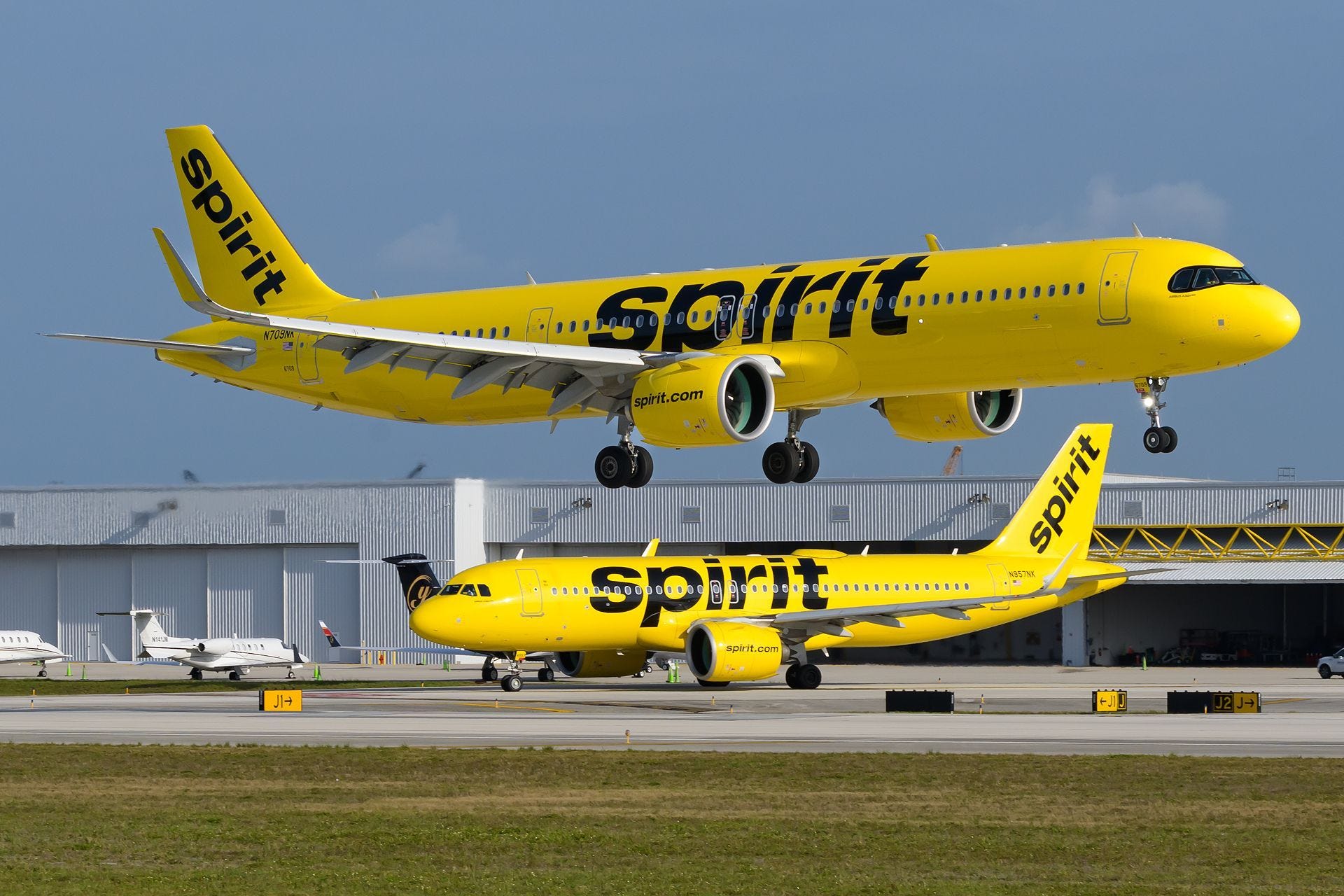
Saturday morning, May 2nd. Millions of Americans woke up and checked their phones to find a message no traveler ever wants to see: your flight is canceled. Not delayed. Not rescheduled. Gone. The airline is gone.
“It is with great disappointment that on May 2, 2026, Spirit Airlines started an orderly wind-down of our operations, effective immediately. All flights have been cancelled, and customer service is no longer available.”
Just like that. Thirty-four years. Over.
This didn’t come out of nowhere. Spirit’s collapse has been building for years, through bad bets, blocked mergers, two bankruptcies, and finally a war in the Middle East that sent jet fuel prices off the charts. But the story of how Spirit died is also the story of something bigger: what happens to regular Americans when the budget option disappears.
The numbers first
Spirit had about 9,000 flights scheduled from May 2 through the end of the month, a total of 1.8 million seats. That’s an average of 300 flights and 60,000 potential passengers a day, left scrambling. About 17,000 jobs could be impacted. 
Those aren’t statistics. Those are families stranded at airports, workers without paychecks, and people who booked the only fare they could afford, now told to figure it out.
How we got here
Spirit’s problems didn’t start this year. The airline had been struggling financially for years, filing for bankruptcy twice, in November 2024 and then again in August 2025, due to continued losses, high debt, and intense competition from other airlines.
The model had been cracking for a while. “When you’re a low-cost carrier, by definition, you’re relying on having a cost advantage. And they just don’t have that anymore,” said Shye Gilad, a former airline pilot and professor at Georgetown University’s McDonough School of Business. “They just don’t have a lot of options left.”
Then came the Iran war. And it was the last straw.
Spirit’s restructuring plan had assumed jet fuel costs of about $2.24 a gallon in 2026. By the end of April, prices had climbed to about $4.51 a gallon, more than double, leaving the carrier unable to survive without new financing. Three days after Spirit announced a deal with creditors in February to emerge from bankruptcy, the war in Iran started, choking off about 20% of the world’s oil supply and sending jet fuel prices soaring.
Timing doesn’t get crueler than that.
The bailout that wasn’t
Here’s where it gets political.
In recent weeks, Spirit had been in very advanced discussions with the Trump administration on a rescue package, a $500 million cash infusion in exchange for a significant potential stake in the company. Unions representing Spirit’s pilots, flight attendants, and ramp workers pushed hard for the deal. Jobs were on the line. Communities were on the line.
It fell apart at the last minute. A key group of creditors rejected the plan. On Friday, Trump acknowledged reality: “We’re looking at it, but if we can’t make a good deal, no institution’s been able to do it. I’d like to save the jobs.”
By Saturday morning, there were no jobs left to save.
Trump administration officials then took to social media to blame the Biden administration for Spirit’s demise, pointing to Biden’s opposition to a proposed merger between Spirit and JetBlue in 2023. There’s truth in that. The blocked merger likely was the beginning of the end. But blaming a predecessor doesn’t put 17,000 people back to work or refund the 60,000 daily passengers left holding worthless tickets.
What this means for your wallet
Let’s be direct with you: Spirit’s death is going to cost you money, even if you never once set foot on a yellow plane.
“You do not have to fly a small carrier in order to benefit from its presence, because they will bring down the big guys’ fares,” said William McGee, a senior fellow at the American Economic Liberties Project. Without Spirit flying those routes, “everyone will be paying more.”
That’s not an opinion. That’s how airline economics work. Spirit’s ultra-low fares forced Delta, United, American, and Southwest to compete on price on every route Spirit flew. Now that pressure is gone. Removing the 2% of domestic US flights Spirit was scheduled to fly this summer will push fares higher across the entire industry. 
Budget-conscious travelers will feel it most. Leisure travelers in places where Spirit had a big footprint, Las Vegas, Fort Lauderdale, and similar markets, will likely feel the absence most acutely. Spirit had a market share of about 27% in Fort Lauderdale alone. That’s not a footnote. That’s a market restructured overnight.
If you’re stranded right now
The practical reality for passengers caught mid-trip or holding upcoming tickets:
United Airlines, Delta Air Lines, JetBlue Airways and Southwest Airlines are capping fares for Spirit passengers, with prices expected to be about $200 for a one-way ticket. That’s the good news. The bad news: Spirit said it will not reimburse customers for incidental travel costs associated with canceled trips, though travel insurance may cover costs for those who purchased it. Potential refunds for rewards, coupons and vouchers will be determined through the bankruptcy court process. 
In plain language: get on a competitor’s flight, save your receipts, and don’t hold your breath for Spirit to make you whole anytime soon.
The bigger picture
Spirit is the first American airline to fully collapse since the pandemic era. It will not be the last if the Iran war keeps fuel prices where they are. American Airlines has said that every penny that jet fuel prices rise costs the airline $50 million over the course of a year. United said last month that if fuel prices continue at their current level, the airline could incur $11 billion in additional expenses, double its highest-ever annual profit.
The big carriers can absorb that, painfully, but they can. Smaller ones cannot. German airline Lufthansa canceled 20,000 flights last month to protect itself from soaring fuel costs. India’s Air India increased fuel surcharges on all flights and reduced 100 flights a day.  The aviation industry is in a slow-motion crisis that most Americans haven’t fully registered yet.
Spirit just became the first visible casualty on US soil.
The bottom line
Spirit wasn’t a beloved airline. The fees were maddening, the seats were thin, and the complaints were endless. But it served a real purpose for real people, the ones who couldn’t afford the legacy carriers, who just needed to get somewhere without draining a savings account.
That option is now gone. The Iran war, two bankruptcies, a failed merger, and a bailout that fell apart at the last hour all converged on the same outcome. Thirty-four years of flying, ended by a press release at 3 in the morning.
Seventeen thousand workers. Sixty thousand daily passengers. Higher fares for everyone else.
Some collapses happen in slow motion. You watch them coming for years. This one still managed to hit like a gut punch when it finally arrived.
We’ll keep watching what happens to air travel and to your money as this shakes out.
That’s what this letter is for.
— US Daily Letter | May 4, 2026
Sources: NPR, CNN, Fortune, Al Jazeera, Georgetown University
Subject line: Spirit Airlines is dead. Here’s what it costs you.
Preview text: 17,000 jobs gone. 60,000 passengers stranded. And your fares are about to go up.