


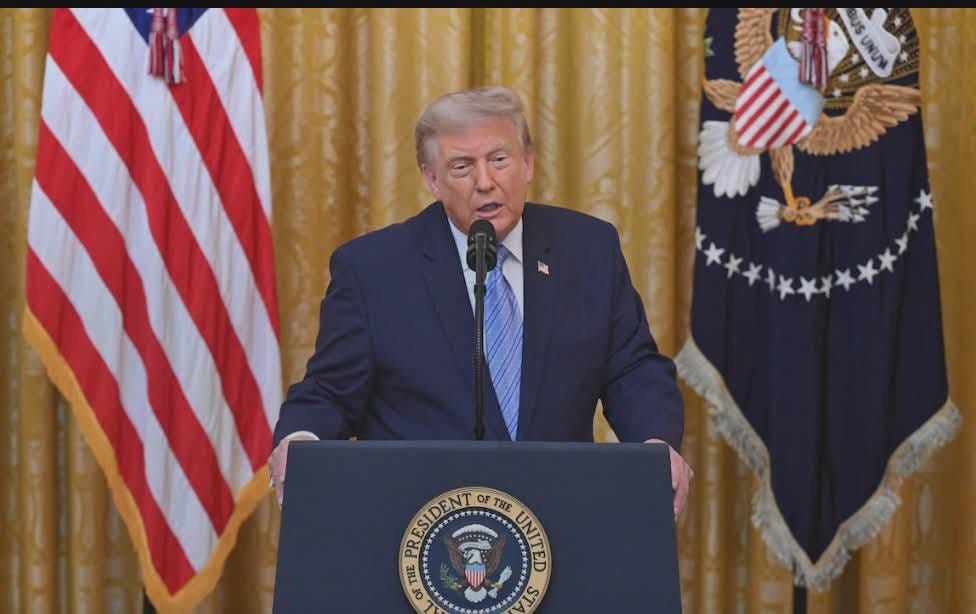
Last night at 9pm Eastern, President Trump addressed the nation from the East Room of the White House in a 25-minute primetime speech on election security. NBC, ABC, CBS, and CNN declined to carry it on their main television channels, streaming it on digital platforms instead. Fox News carried it in full. Whatever you think about that editorial decision, it means millions of Americans either watched it through a particular lens or did not watch it at all. Here is the unbiased breakdown of what actually happened.
1. The headline claim: China stole 220 million voter files
Trump opened with what he called the central revelation of the evening. Starting during the 2020 election cycle, he said, the People’s Republic of China carried out what is believed to be the largest compromise of election data in history, acquiring 220 million US voter files including names, addresses, phone numbers, and political party preferences. That number is real and the underlying concern about Chinese acquisition of American data is legitimate. What the declassified documents actually show is more complicated. Several of the files draw partly from publicly available voter registration data, and one heavily redacted assessment described China’s interest as newly identified for a specific individual actor rather than a systematic state-directed operation.
2. The documents were largely not new
Trump called the declassified files shocking and said they had been hidden from both him and the American public. An early review by CNN found that the documents largely discuss previously known potential vulnerabilities in the American election system and issues that were included in a 2021 assessment from the US intelligence community. The vulnerabilities described are real. The framing that they were concealed from the public does not survive contact with the public record.
3. He accused the deep state of a cover-up
Trump claimed that rogue bureaucrats operating a shadow government had deliberately suppressed information about Chinese election interference to protect his political opponents. He named Obama and Biden administration officials as participants in what he called a systematic cover-up. No specific evidence for the cover-up claim was presented in the speech or in the released documents beyond the assertion itself.
4. The Michigan voter registration claim
This was the most specific allegation of the night. Trump said FBI files detail evidence of alleged fraud by a large-scale voter registration operation in Michigan. He referenced a 2020 Michigan State Police raid on a Democratic get-out-the-vote organization in Muskegon, where canvassers allegedly admitted to signing voter registration forms in other people’s names. That raid happened. The FBI did investigate. What Trump did not say is that Michigan officials reviewed those cases at the time and found no evidence of votes being cast fraudulently as a result. Registration irregularities and votes actually cast are different things. The speech treated them as the same.
5. China wanted Trump to lose. He is not wrong about that.
One of the clearer claims in the speech is also one of the more straightforwardly accurate. Trump quoted CIA reports concluding that China wanted the US president to lose the next election. The declassified documents support that general conclusion. US intelligence agencies have consistently assessed that China preferred a Biden presidency in 2020 because of concerns about Trump’s trade and technology policies. Where Trump’s framing diverges from the intelligence record is the next step: preferring an outcome and successfully manipulating an election to achieve it are two very different things. The intelligence community concluded China chose not to directly interfere in the 2020 vote.
6. The non-citizen voter claim
Trump cited a DHS evaluation finding that 278,000 non-citizens are registered to vote in federal elections. This number deserves scrutiny. Voter rolls contain errors, outdated information, and people who registered legally as permanent residents before understanding the rules. The number of non-citizens who actually cast ballots in federal elections, as opposed to appearing on rolls, has consistently been found by election officials and independent researchers to be extremely small. The distinction between being registered and actually voting was not made in the speech.
7. He said this was not meant to weaken confidence in elections. Then he said the opposite.
Trump explicitly stated that the purpose of the speech was not to weaken confidence in US elections. He said it three times in different formulations. He then spent twenty-two of the twenty-five minutes of the speech describing American election infrastructure as catastrophically short of required standards, compromised by a foreign adversary, and covered up by the previous administration. Those two things cannot both be true simultaneously. You cannot spend twenty-two minutes describing a system as catastrophically compromised and then claim you are building confidence in it.
8. The timing is the story
The 2026 midterm elections are four months away. Republicans are defending their House majority. Trump’s approval rating is underwater at roughly 38 percent. The Iran war, gas prices, the Medicaid cuts, and the heat deaths over the Fourth of July weekend have produced a political environment that is difficult for the party in power. A primetime speech four months before midterms about the vulnerability of the electoral system to foreign manipulation, delivered without major new evidence, in which the president pledges federal agencies will work with states to address vulnerabilities before November, is not primarily a national security address. It is a political document. That does not make every claim in it false. It does mean the framing deserves that context.
9. The practical announcement buried at the end
The most concrete thing Trump announced last night came in the final two minutes and received almost no coverage. He said his administration is notifying states whose election data was compromised by China, that DHS will hold a formal briefing on election security, and that federal agencies are committing to work with states and local jurisdictions to fix and patch known technical vulnerabilities before November. Those are real actions that election security professionals have been asking for regardless of party. If they happen, they are worth covering seriously. Whether they happen is a different question.
10. The major networks made a choice and it matters
NBC, ABC, CBS, and CNN declining to carry a presidential primetime address on their main channels is not a routine editorial decision. It has happened before, but rarely. The networks’ reasoning was that the speech would likely contain false or misleading claims about elections that they did not want to amplify. That reasoning is understandable and may be correct. It is also worth naming directly: when the major broadcast networks decide a sitting president’s primetime address is not worth carrying live, and the president’s allies say the networks are suppressing the truth, and the president’s critics say the networks are doing their job, the gap between those two realities is itself the story. Americans living inside one of those realities and not the other are watching completely different versions of the same twenty-five minutes. That division is not an accident and it is not going away.
That is what this letter is for.
— US Daily Letter | July 17, 2026