


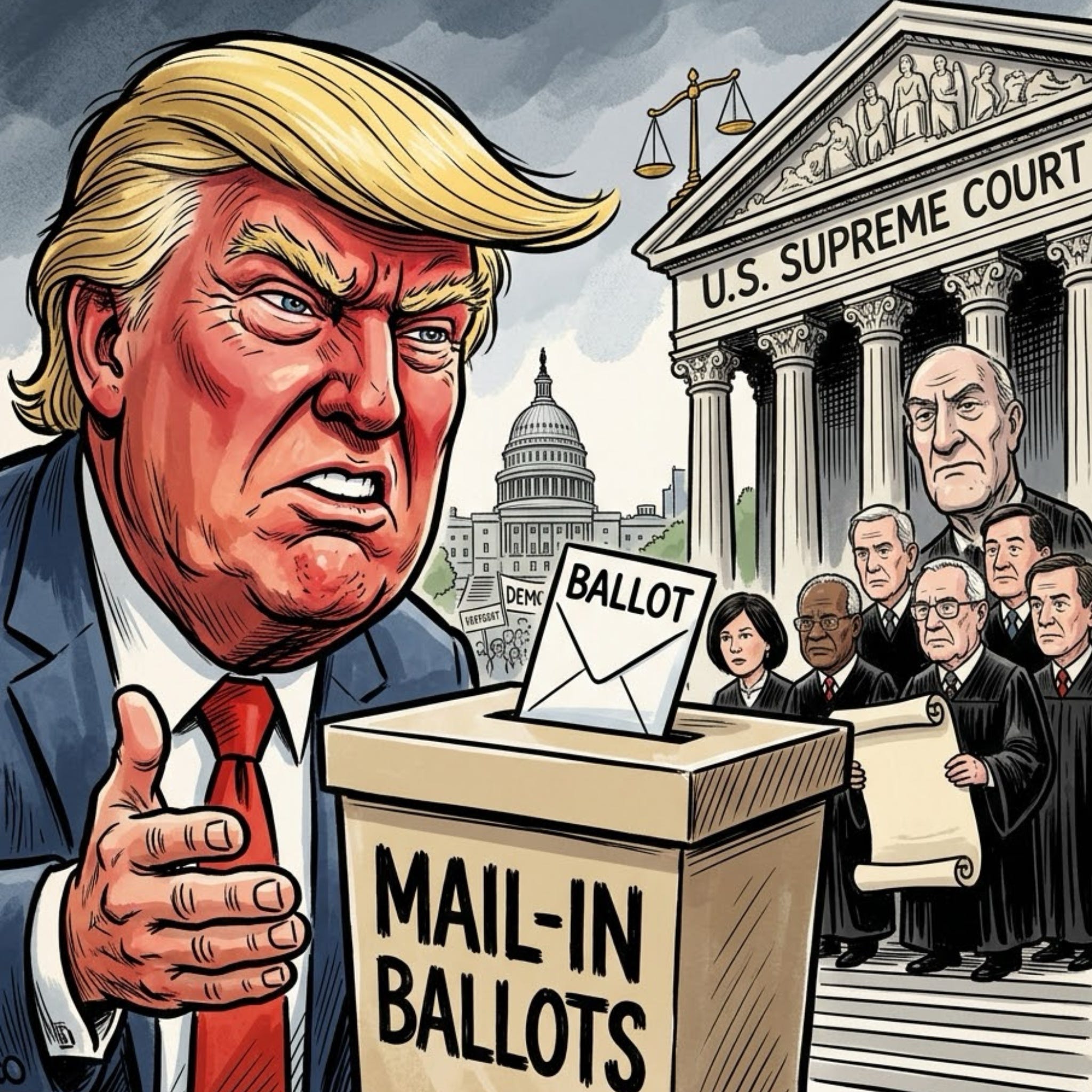
Monday morning, the Supreme Court of the United States issued a brief, unsigned order that stopped one of the most consequential attempts to reshape American election procedures in modern history. President Trump wanted to restrict how the US Postal Service handles mail-in ballots for the November midterms. The Court, the one with six justices appointed by Republican presidents, three of them by Trump himself, said no.
The order was three sentences long. It did not need to be longer.
“The Government is unlikely to succeed on the merits of its challenge to the District Court’s preliminary injunction,” the Court wrote. “And the equitable factors applicable for obtaining emergency relief from this Court do not favor a stay.”
In plain language: the administration probably loses this case when it goes to trial, and the disruption of changing election rules weeks before an election where voting is already underway is too great to risk. The restrictions stay blocked. The 47 million Americans who vote by mail can continue to do so exactly as they planned.
Two justices dissented publicly: Samuel Alito and Clarence Thomas. That is the number worth holding onto as you read the rest of this.
What Trump was actually trying to do
The restrictions came through a rule issued by the US Postal Service, which the administration argued gave the federal government authority to regulate how ballots move through the mail without technically regulating elections themselves. The rule imposed new envelope design requirements and addressee information requirements for federal election ballots sent through the mail. Election officials would have had to know exactly who sent each ballot before it was processed.
The administration called it a modest envelope design and addressee information requirement. Critics called it something else entirely.
What the rule would have done in practice is require states and local election jurisdictions to redesign their mail ballot envelopes and update their systems, weeks before an election, in a compressed window of time that election officials across the country said was simply not possible. Washington’s Secretary of State said election workers were already hard at work preparing to carry out a safe, secure, and accurate election and that the disruption would have been severe. The League of Women Voters, whose CEO Celina Stewart was among the most vocal opponents, put it plainly: “The Postal Service exists to deliver Americans’ mail, not to rewrite election rules, demand voters’ personal information, or decide which ballots make it through the system.”
US District Judge Indira Talwani blocked the rule in August, finding it likely violated the Constitution and was impossible to apply given the timing of the elections. The administration appealed. The appeals court upheld the block. The administration went to the Supreme Court. The Supreme Court said no.
The dissent that tells you where this goes next
Alito and Thomas dissented. That is two justices. That means seven justices, including Kavanaugh and the rest of the Court’s conservative bloc, voted to keep the restrictions blocked.
But read Kavanaugh’s concurrence carefully, because it contains the next chapter of this story. Kavanaugh wrote that he believes there is at least a fair prospect that the final rule falls within the Postal Service’s statutory authority. He agreed with blocking it for the midterms not because he thinks the administration is wrong on the law, but because applying it now would be arbitrary and capricious in violation of the Administrative Procedure Act, since state and local election officials do not have sufficient time to implement it before the elections.
That is a very specific and very significant caveat. Kavanaugh is telling the administration that the door is not closed. He is saying you cannot do it now, for these elections, with this timeline. He is not saying you can never do it.
The administration’s legal team almost certainly read that concurrence within minutes of it being posted and began planning accordingly. The fight over mail-in voting is not over. It has been paused for November. The version of this rule that comes back before the Court after the midterms, with adequate implementation time built in, may well get a different answer from at least one justice who voted against it today.
What the numbers say
One third of the American electorate voted by mail in 2024. That is 47 million people. They voted from hospitals and nursing homes and military bases and rural areas where driving to a polling place means a two-hour round trip. They voted because they work two jobs and cannot afford to stand in line for three hours on a Tuesday. They voted because they are disabled. They voted because they planned ahead and mailed their ballot two weeks early.
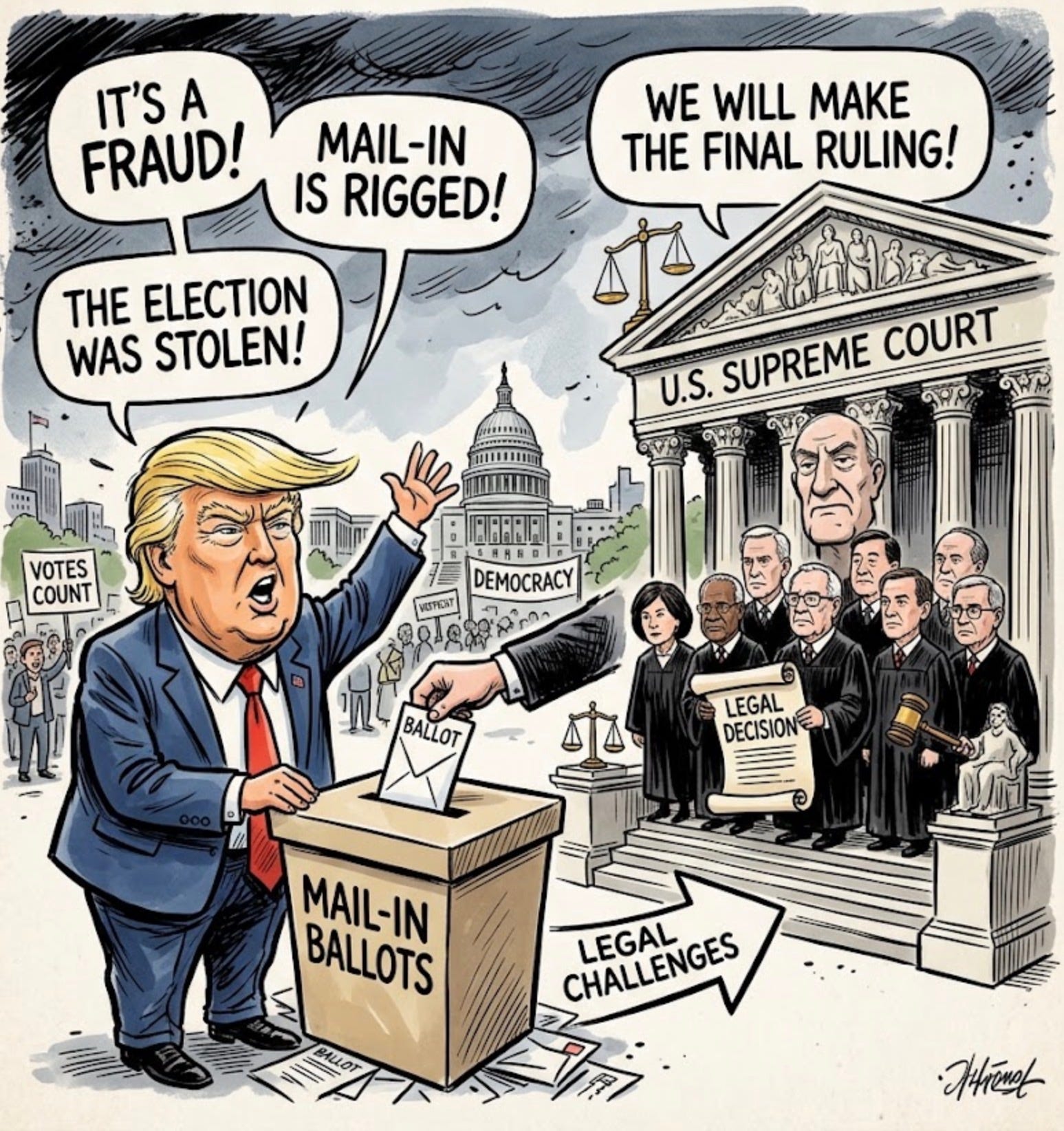
There is virtually no evidence of fraud in mail-in voting. Every major study, every state-level audit, and every court case that has examined the question has reached the same conclusion. The Obama-appointed judge who originally blocked the rule made that point directly: no evidence of mail-voting fraud was presented in the litigation. The administration did not contest that fact in court. It argued instead that the rule was a matter of postal regulation rather than election regulation, a legal distinction that seven justices declined to accept as sufficient reason to let the rule take effect.
The unbiased read
Here is what both sides of this argument have right.
The administration is correct that the federal government has a legitimate interest in the integrity and administration of federal elections. The Postal Service does have statutory authority to regulate how mail moves through its system. These are not invented powers. Alito’s dissent makes a real legal argument when it says the Postal Service has broad authority to regulate the mail and likely does have the power to enforce Trump’s restrictions. That argument convinced two justices and may eventually convince more.
The critics of the rule are correct that changing election procedures weeks before an election, when voting has already started, with no demonstrated evidence of the fraud the rule is meant to address, creates chaos that falls heaviest on the voters least able to adapt. Elderly voters in nursing homes who received mail ballot applications months ago do not have the ability to suddenly switch to in-person voting because envelope design requirements changed in September. The practical harm of last-minute election rule changes is real and falls disproportionately on specific populations.
Both of those things are true simultaneously. A legal authority can exist and still be exercised at a moment and in a manner that causes disproportionate harm. The Court’s majority concluded that the balance of those considerations favored keeping the block in place. Two justices disagreed. That is what a functioning court looks like.
What this means for November
The midterms are 51 days away. Voting has already begun in several states. The Supreme Court’s order this morning means that the election will proceed under the rules that states have built their systems around, the same rules that governed 2024, 2022, and 2020.
For the 47 million Americans who planned to vote by mail, nothing changes today. Your ballot application is still valid. Your envelope is still the right design. Your vote will still be processed the way it was always going to be processed. That is the practical bottom line of this morning’s order.
For the broader argument about mail-in voting, about who controls election administration, about the line between federal postal authority and state election authority, nothing is settled. Kavanaugh’s concurrence practically handed the administration a roadmap for the next version of this fight. The question of whether the Postal Service can regulate ballot mail will come back before the Court. When it does, it will come with more time and fewer emergency docket constraints. The answer may be different.
This morning’s ruling protects this election. It does not end the debate about the next one.
That is what this letter is for.
— US Daily Letter | September 15, 2026