


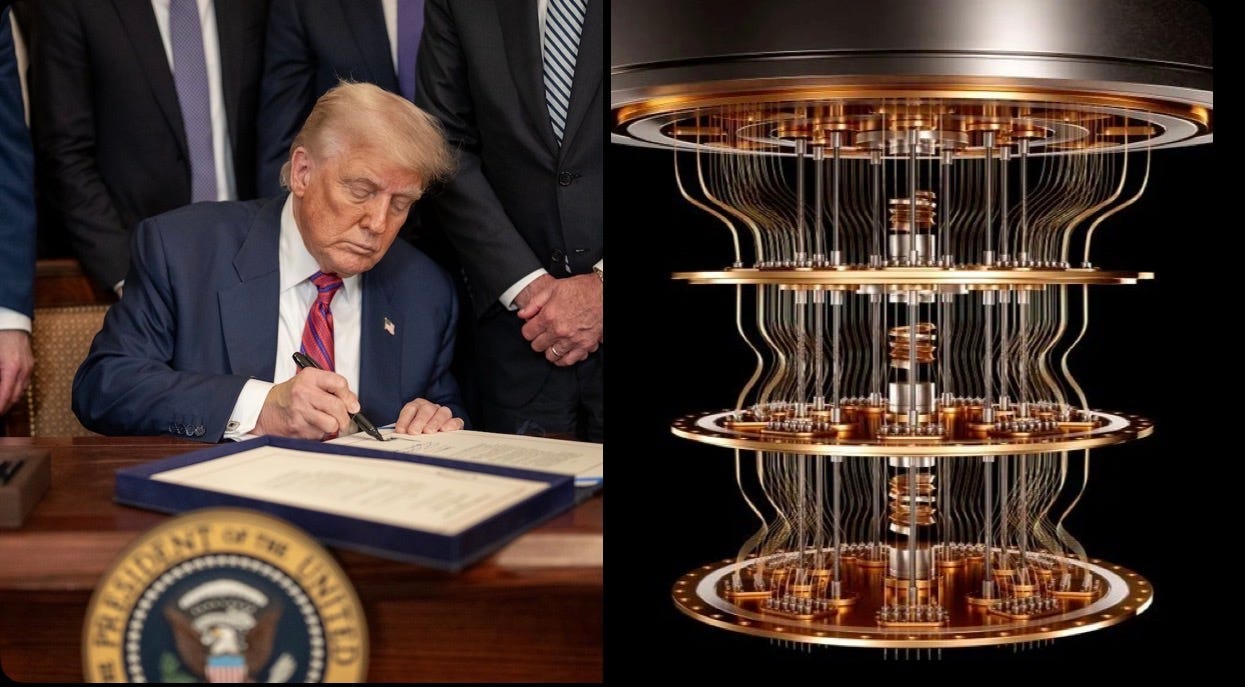
Two executive orders. One quiet revolution in American national security. And a deadline that affects every bank account, medical record, and government secret in the country.
Yesterday, Monday June 22nd, Donald Trump signed two executive orders that almost nobody outside the tech world is talking about. The Iran deal is getting the headlines. The World Cup is getting the eyeballs. Meanwhile, something genuinely significant happened in Washington that will affect the security of your bank account, your medical records, and the classified secrets of the United States government for the next decade and beyond.
The subject is quantum computing. Before you click away, hear this out. Because the part that matters most to ordinary Americans is not about physics. It is about a clock that is already ticking.
What Trump actually signed
Two orders. Think of them as an offense and a defense working together.
The first is the offensive play. It commits the United States to building a research-grade quantum computer, housed in a national laboratory, by 2028. IBM CEO Arvind Krishna was in the room. So was Alphabet President Ruth Porat. So was a Nobel Prize-winning physicist. The government is not doing this alone. The funding picture makes that clear: $1 billion to IBM, $375 million to GlobalFoundries, $100 million each to D-Wave, Rigetti, and Infleqtion, on top of $2 billion already directed from the CHIPS and Science Act in late May. This is not a research grant. It is an industrial policy.
The second order is the defensive play, and it is the one every American should understand. It requires federal agencies to migrate to post-quantum cryptography by December 31, 2030, with digital signatures updated by December 31, 2031. Every federal contractor must comply by the same deadline. NIST, CISA, and the NSA are all tasked with providing the technical guidance to get there.
In plain language: the United States government has given itself five years to change every lock on every door before someone builds a key that can open all of them at once.
The threat you have not heard about
The encryption protecting your bank account, your medical records, and the classified communications of the US military is built on a mathematical problem that classical computers cannot solve in any reasonable time. Breaking it would take longer than the age of the universe. That is why we trust it.
A sufficiently powerful quantum computer changes that equation entirely. It could break today’s encryption in hours. Maybe minutes. Most experts place Q-day, the moment that becomes possible, somewhere in the 2030s.
That sounds far away. It is not, for one specific reason.
Adversaries can steal encrypted data today and store it, waiting until a future quantum computer unlocks it. Security experts call this harvest now, decrypt later. China and other state actors are almost certainly doing it right now. Every classified document, every intercepted communication, every sensitive file that has ever moved across a network could be sitting in a foreign server farm, waiting for the day the quantum key gets built.
The executive order is a recognition that the United States cannot wait for Q-day to start protecting itself. Five years is not a comfortable runway. It is a tight one.
The China race underneath everything
These orders exist in the context of a technology race with China that has been accelerating for a decade. China’s government-backed quantum programs are among the best-funded in the world. The FBI has warned for years that Chinese intelligence is actively targeting American quantum research, recruiting researchers and stealing intellectual property.
The orders direct the FBI to expand its Quantum Counterintelligence Protection Team and task the Director of National Intelligence with strengthening protections around quantum research. The government is not just trying to build the best quantum computers. It is trying to make sure nobody steals the blueprints while it does.
As one analyst noted, adversaries do not need a quantum computer to steal quantum breakthroughs. They only need access.
What it means for you personally
If the federal government fails to migrate to post-quantum cryptography before Q-day, the consequences reach well beyond classified military files. Social Security records. Tax returns. Medicare data. Veterans health files. Every piece of sensitive information the government holds about every American is currently protected by encryption a quantum computer could eventually break.
The order also extends beyond federal agencies. CISA must help critical infrastructure operators develop post-quantum adoption plans covering water systems, power grids, and financial networks. The quantum-resistant security push is going into the infrastructure that keeps American daily life functioning.
For readers who follow markets, the signal was immediate. Several publicly traded quantum companies drew fresh attention after the announcement. Government demand at this scale, with dollar amounts and firm deadlines attached, removes the largest single risk factor for long-term investment in the sector.
The bottom line
Two executive orders signed on a Monday afternoon. The Iran deal and the World Cup will get the attention this week. But these two documents may ultimately matter more to the daily security of ordinary Americans than either of those stories.
The United States has declared, officially and with funding attached, that quantum computing is a strategic national priority. It has set a deadline for protecting its own systems before the technology it is racing to build becomes a weapon in someone else’s hands.
The clock is running. The harvest is already happening. Someone in Washington finally decided to start changing the locks.
That is what this letter is for.
— US Daily Letter | June 23, 2026