


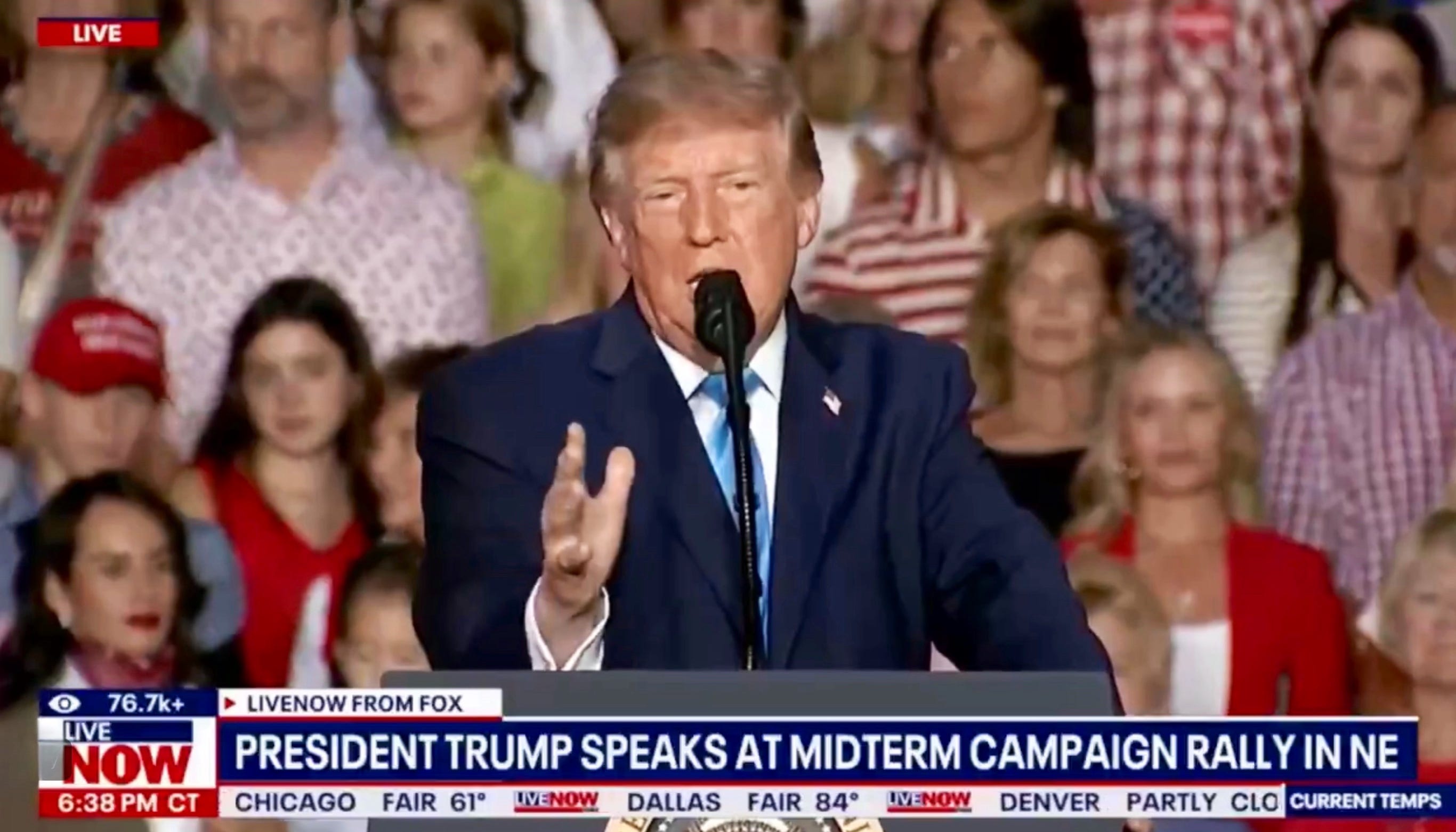
Monday night in Grand Island, Nebraska, Donald Trump stood in front of a crowd at the Pinnacle Bank Expo Center and said something that no sitting American president has ever said in the history of this republic.
He told them to let Iran destroy Los Angeles.
The full quote, verified, is this: “Remember, with the war, it’s just artificial. They can take out a city. Let them take out Los Angeles. Let them take out San Diego. It’s a small price to pay for keeping the world safe, keeping our country safe.”
The crowd cheered.
Take a moment with that. The president of the United States, at a campaign rally 28 days before the midterm elections, named two specific American cities and said it would be a small price to pay for Iran to destroy them. Not a slip of the tongue. Not a misquote. A full sentence, delivered to applause, about the acceptable destruction of Los Angeles and San Diego.
By morning, every major California official was responding. Los Angeles Mayor Karen Bass wrote: “The role of a president is to protect the country, not to actively threaten it and encourage attacks on American lives.” Governor Gavin Newsom called the remarks deranged. The Los Angeles city council released a joint statement. San Diego’s mayor demanded an apology. None of them got one.
What they got instead was Trump’s Rapid Response Team posting on X: “No, he didn’t, you buffoons. He was saying the U.S. is fighting to STOP Iran from having the ability to take out LA and San Diego with a nuclear weapon.”
That explanation deserves to be examined seriously, because it is the only defense available and it does not hold.
What Trump actually said and what it means
Read the quote again. Trump did not say Iran is trying to take out Los Angeles and we are fighting to stop them. He said let them take out Los Angeles. The word let is doing enormous work in that sentence. Let means permit. Let means allow. Let means stand aside and accept the outcome. You do not say let them do something when you are describing what you are trying to prevent.
The White House rapid response team is asking you to read “let them take out Los Angeles” as shorthand for “we are fighting to prevent them from taking out Los Angeles.” Those are not the same sentence. They are not even close to the same sentence.
The broader context of the remarks makes the rapid response interpretation harder to sustain, not easier. Trump was defending the economic pain Americans are experiencing from the Iran war, specifically the elevated gas prices and inflation that have dominated the midterm conversation for months. His argument was that the price increases are artificial and temporary, and that they are worth paying. Then he offered a comparison to illustrate his point: even if Iran destroyed a city, that would be a small price to pay for keeping the country safe.
That is an argument about proportionality and sacrifice. It is not a statement about what America is fighting to prevent. It is a statement about what America could survive. The distinction is not semantic. It is the entire point.
The political moment this landed in
Trump made these remarks at a campaign rally designed to boost Republican candidates ahead of the November 3rd midterms. He was in Nebraska, not California. The crowd was not made up of Los Angeles residents. It was made up of people for whom Los Angeles is frequently invoked as a symbol of everything wrong with the Democratic Party and liberal America.
That context does not excuse the remark. It explains the incentive structure that produced it. Trump has spent two years running against California as a political strategy. He vetoed California’s governor for higher office, attacked its cities, cut its federal funding, and used it as a foil at rally after rally. Los Angeles and San Diego are not just cities to this crowd. They are symbols. And telling that crowd that those symbols could be destroyed for a small price landed differently than it would have landed in, say, a security briefing or a presidential address.
Los Angeles is the second largest city in the United States. Nearly four million people live there. San Diego has 1.4 million residents. Together the metro areas contain more than 13 million Americans. The president of the United States said their cities could be taken out and called it a small price. Whether he meant it literally or as rhetorical flourish about nuclear deterrence, the words came out of his mouth at a microphone in front of a cheering crowd 28 days before an election.
That is the record. It cannot be walked back with a social media post calling critics buffoons.
What this tells you about the war and where it is going
Here is the part of this story that gets less attention than the controversy and matters more.
Trump did not make these comments in isolation. He made them the same week a third aircraft carrier strike group left San Diego, bound for the Middle East, alongside 2,000 Marines. He made them after telling Time magazine that new strikes on Iran after the midterms are possible. He made them after rejecting Iran’s latest peace proposal as unacceptable. He made them after 221 days of a war that has not produced a deal, not reopened the Strait of Hormuz completely, not resolved the nuclear question, and not come close to the clean victory his administration promised.
The Grand Island rally was not primarily about foreign policy. It was about midterm turnout. But the remark about Los Angeles and San Diego revealed something about how Trump is thinking about the Iran war heading into November: not as a crisis to resolve before the election but as a political asset to perform around. The gas prices are a small price. The potential destruction of cities is a small price. The whole framing is an argument that the war’s costs are acceptable, not that the war is ending.
He also told the crowd, at another point in the same speech: “By the way, we’re kicking Iran’s ass.”
A deal is not coming before November 3rd. The third carrier will be in position by then. Trump has told aides he expects to resume bombing after the midterms. The rally in Nebraska was not a moment of presidential restraint. It was a preview of what the next chapter looks like.
What the mayor of Los Angeles said
Karen Bass has run one of the largest cities in the world through wildfires, economic strain, and a World Cup. She is not given to hyperbole. Her statement Monday night was direct and worth reading in full: “His statements against our city are dangerous and could potentially compromise our safety. The role of a president is to protect the country, not to actively threaten it and encourage attacks on American lives. In the face of irresponsible threats, as Angelenos, we know how to stand together and protect our city.”
She said his remarks could compromise the city’s safety. That is not a political attack. That is a mayor saying that a president publicly suggesting her city is an acceptable target creates a real and specific danger. Whether you agree with her politics or not, that concern is legitimate and deserves to be taken seriously rather than dismissed with a buffoons post.
The bottom line
Twenty-eight days before the midterms. A third aircraft carrier heading to the Middle East. A war with no deal in sight. And a president standing in Nebraska telling a cheering crowd that letting Iran destroy Los Angeles and San Diego would be a small price to pay.
The White House says he was misunderstood. The quote is what it is.
Every American gets to decide what to make of it. The ones who live in Los Angeles and San Diego have already started.
That is what this letter is for.
— US Daily Letter | October 6, 2026