


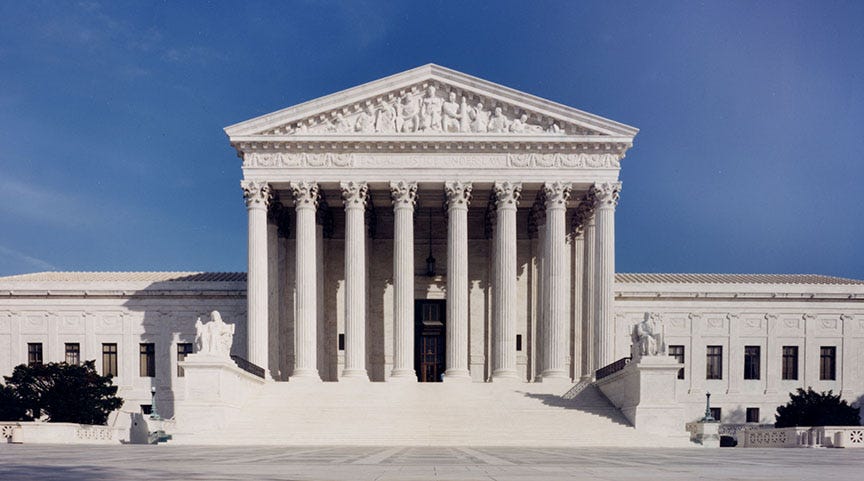
This morning, the Supreme Court ruled on something that will affect your money, your mortgage, and the price of groceries for years to come. Most Americans will not hear about it until tonight. That is exactly why we are writing it now.
In a 5-4 decision authored by Chief Justice John Roberts, the Court ruled that President Trump cannot remove Federal Reserve Governor Lisa Cook from her position, at least not yet, and not the way he tried to do it. Cook was the first Governor to be fired in the central bank’s 111-year history. The Court blocked her removal and sent the underlying question back to the courts to be resolved through proper legal process.
The ruling is narrow. It is procedural. And it is far more consequential than either of those words suggests.
What actually happened
In August 2025, Trump posted screenshots on Truth Social of a letter firing Cook from the Fed, contending that before joining the Fed she had committed mortgage fraud by designating both a house in Michigan and a condo in Atlanta as her primary residence when taking out loans within a two-week period. The allegations came from a Trump-appointed official. Cook denied everything and went to court immediately.
The Supreme Court’s opinion was pointed on the procedural failure: “At minimum, Cook was entitled to some explanation of the evidence at issue, some avenue for a response.”
The Court did not rule that Trump can never fire a Fed governor. It ruled that you cannot fire someone without telling her what she is accused of and giving her a chance to respond. That principle is older than the Constitution itself.
Cook was direct about what she believed was really happening: “This was never about mortgage documents signed years before I became a Federal Reserve governor. It was an attempt to remove me on a manufactured pretext because I refused to bow to political pressure and continued to set interest rates based only on what would best serve the American people.”
Trump called the decision “strictly procedural” and vowed to pursue the case further.
The ruling that landed alongside it
On the same morning, in a separate case, the Court expanded presidential power significantly. The justices overturned a key 1935 ruling called Humphrey’s Executor v. United States, giving Trump far broader authority to remove members of independent agencies previously shielded from political removal. Chief Justice Roberts wrote: “Our Constitution creates three branches, but only one president. Subordinates who exercise the president’s power are subject to removal by him.”
So the Court said, in the same breath, on the same morning: the president can fire independent agency heads more freely than before, and he cannot fire this Fed governor the way he tried to. The Court explicitly concluded that the Federal Reserve is different from other independent agencies, based on its unique structure, history, and role in the nation’s financial system.
Justice Kavanaugh, concurring, was blunt: the government’s argument that a president could fire any Fed governor without judicial review “would weaken, if not shatter, the independence of the Federal Reserve.”
Four justices dissented. Their argument is a legitimate constitutional one: if the president heads the executive branch, restricting his ability to remove those who exercise executive power limits his authority in ways the Constitution does not clearly permit. Today’s ruling buys time. It does not settle that argument.
Why this matters to you personally
The Federal Reserve sets the interest rate that determines what you pay on your mortgage, your car loan, and your credit card. The entire theory behind its independence is that monetary policy should be made on economic evidence, not on what is politically convenient for whoever is in the White House.
Trump has been publicly demanding interest rate cuts since before his second inauguration. The Fed has declined, citing inflation supercharged by the Iran war and the energy crisis. Cook voted with the majority to hold rates steady. The attempted firing cannot be separated from that context.
The unbiased read
Both sides have something right here.
The administration is correct that presidential authority over the executive branch is a real constitutional principle and that independent agencies with no direct electoral accountability raise legitimate questions about democratic governance. Four Supreme Court justices said so today.
Cook and her defenders are correct that the Federal Reserve’s independence from short-term political pressure is one of the structural pillars of the American economy. Markets trust the Fed precisely because it is not simply an instrument of whoever won the last election. Eroding that trust lands on ordinary people in the form of higher borrowing costs and more volatile prices.
Both things can be true simultaneously. A president can have a legitimate constitutional interest in executive accountability and still have chosen a method that bypassed the procedural protections the law requires.
The Court drew a line around the Federal Reserve today. The underlying lawsuit continues. The constitutional question remains unresolved. And Trump has already signaled he intends to pursue it.
How long that line holds is the question the next chapter of this case will answer.
That is what this letter is for.
— US Daily Letter | June 29, 2026