


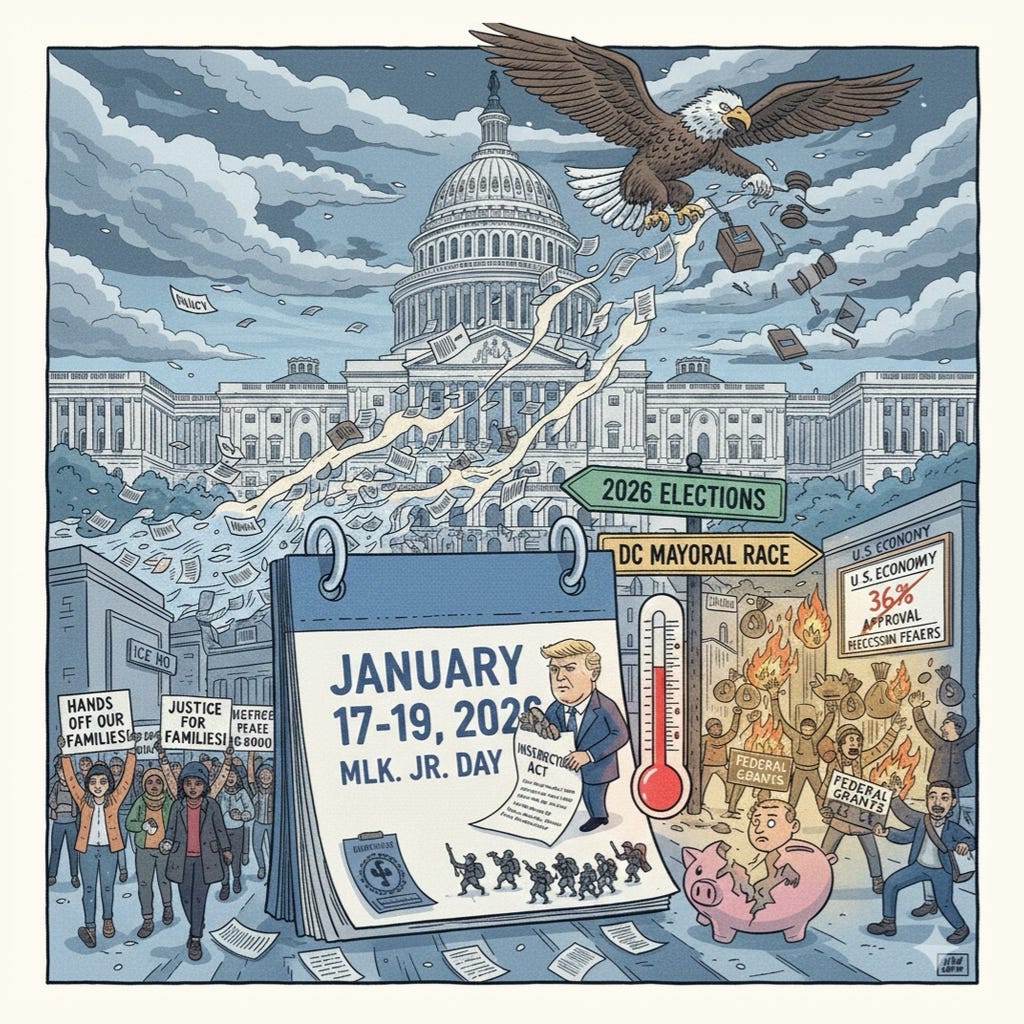
Your guide to the week ahead in politics, policy, and markets
January 17-19, 2026
As Washington observes Martin Luther King Jr. Day weekend, the nation’s capital finds itself at a critical juncture where policy tensions, economic uncertainty, and political realignment converge. Here’s what you need to know heading into the shortened work week.
Immigration Enforcement Dominates National Conversation
The Trump administration’s aggressive immigration enforcement posture continues generating political turbulence following protests in Washington on Sunday over the killing of Renée Good, a 37-year-old mother of three, in Minneapolis by a U.S. Immigration and Customs Enforcement officer. More than a thousand people marched through downtown D.C. to the ICE headquarters.
President Trump has indicated he could invoke a centuries-old law that would give him sweeping powers to deploy the military in U.S. cities as protests grow over violent ICE enforcement actions. The possibility of invoking the Insurrection Act represents a significant escalation in executive power that would reshape federal-local dynamics across multiple jurisdictions.
The political ramifications extend beyond immediate enforcement concerns. Democrats are calculating how immigration messaging will play in the 2026 midterm elections, while Republicans face pressure to demonstrate results on a signature campaign promise even as implementation generates controversy.
Economic Anxiety Persists Despite Technical Indicators
A majority in the recent NPR/PBS News/Marist poll said that the country is already in a recession, even though technically it’s not. Gallup found that two-thirds think that the economy is getting worse and that Trump’s economic approval rating was only at 36%.
The disconnect between official economic metrics and public perception creates political vulnerability for the administration. Trump’s economic approval stands well below his first-term levels, when economic management represented a relative strength. The challenge facing the White House is that presidential messaging alone cannot shift entrenched voter perceptions about affordability and economic trajectory.
As we approach key economic data releases next week, markets will scrutinize retail sales figures for insights into holiday consumer spending and housing data to assess whether residential real estate can maintain momentum. These indicators matter not just economically but politically, as they will influence the scope and sequencing of potential fiscal policy adjustments.
Federal Funding Volatility Creates Uncertainty
The Trump administration sent hundreds of letters Tuesday terminating federal grants supporting mental health and drug addiction services. The cuts could total as much as $2 billion. While funding to programs including those at the American Academy of Pediatrics was initially terminated then restored after a federal judge’s order, the episode illustrates the administrative turbulence affecting organizations dependent on federal support.
The broader pattern of grant terminations and reversals creates operational challenges for nonprofits, state agencies, and local governments that rely on predictable federal funding streams. It also signals potential fiscal priorities as the administration approaches budget negotiations for the remainder of the fiscal year.
DC Political Landscape in Transition
On the local front, Mayor Muriel Bowser has announced she will not seek a fourth term, leading to shifts in the political landscape. The decision ends more than a decade of Bowser’s leadership and opens a competitive field for the 2026 mayoral race.
The political climate in D.C. is heavily influenced by the Trump administration’s rhetoric and policies, particularly concerning crime and federal intervention, highlighting the tension between local autonomy and federal influence. The next mayor will inherit ongoing negotiations over the balance between home rule and congressional oversight — a perennial tension in District governance that has intensified during periods of one-party federal control.
Congressional Positioning for 2026
Republicans’ control of the House is hanging on by just a very thin thread. 2025 electorally was really not good for the GOP, creating strategic challenges for the party heading into the midterm cycle.
The narrow House majority constrains legislative options and elevates individual member leverage on key votes. Leadership faces the delicate task of advancing agenda items while maintaining caucus unity in an environment where every vote counts. Democrats, sensing opportunity, are calibrating their opposition strategy to maximize pickup potential in November.
The Senate map presents different dynamics, with several competitive races likely to determine chamber control. Early positioning is already underway as candidates assess the political environment and potential matchups take shape.
What MLK Weekend Means for Washington
While the three-day weekend provides respite from typical political combat, several MLK-related events carry policy significance. The 21st Annual MLK Holiday DC Peace Walk & Parade takes place Monday with the theme “The Struggle is Real. THE FIGHT IS STILL!”, drawing thousands to Southeast Washington.
Beyond commemorative events, the holiday traditionally serves as an organizing moment for civil rights and social justice organizations to mobilize supporters and frame policy priorities for the year ahead. In an environment of heightened tensions around immigration enforcement and federal-local relations, these gatherings take on additional resonance.
The Week Ahead
Tuesday brings the return of federal workers after the long weekend, with several policy developments poised to advance. Committee hearings resume, agency regulatory processes continue, and the machinery of government returns to full operation after the holiday pause.
The condensed work week will test Washington’s ability to make progress on pressing agenda items before attention inevitably shifts to the approaching 2026 campaign season. For those tracking the intersection of policy and politics, the coming days offer crucial indicators of how both parties are positioning for the battles ahead.
As the capital reflects on Dr. King’s legacy this weekend, the contemporary political challenges facing Washington underscore the ongoing relevance of his vision for justice, equality, and democratic participation. The distance between that vision and current reality remains a defining feature of American political life.