


By US Daily Letter Political Desk
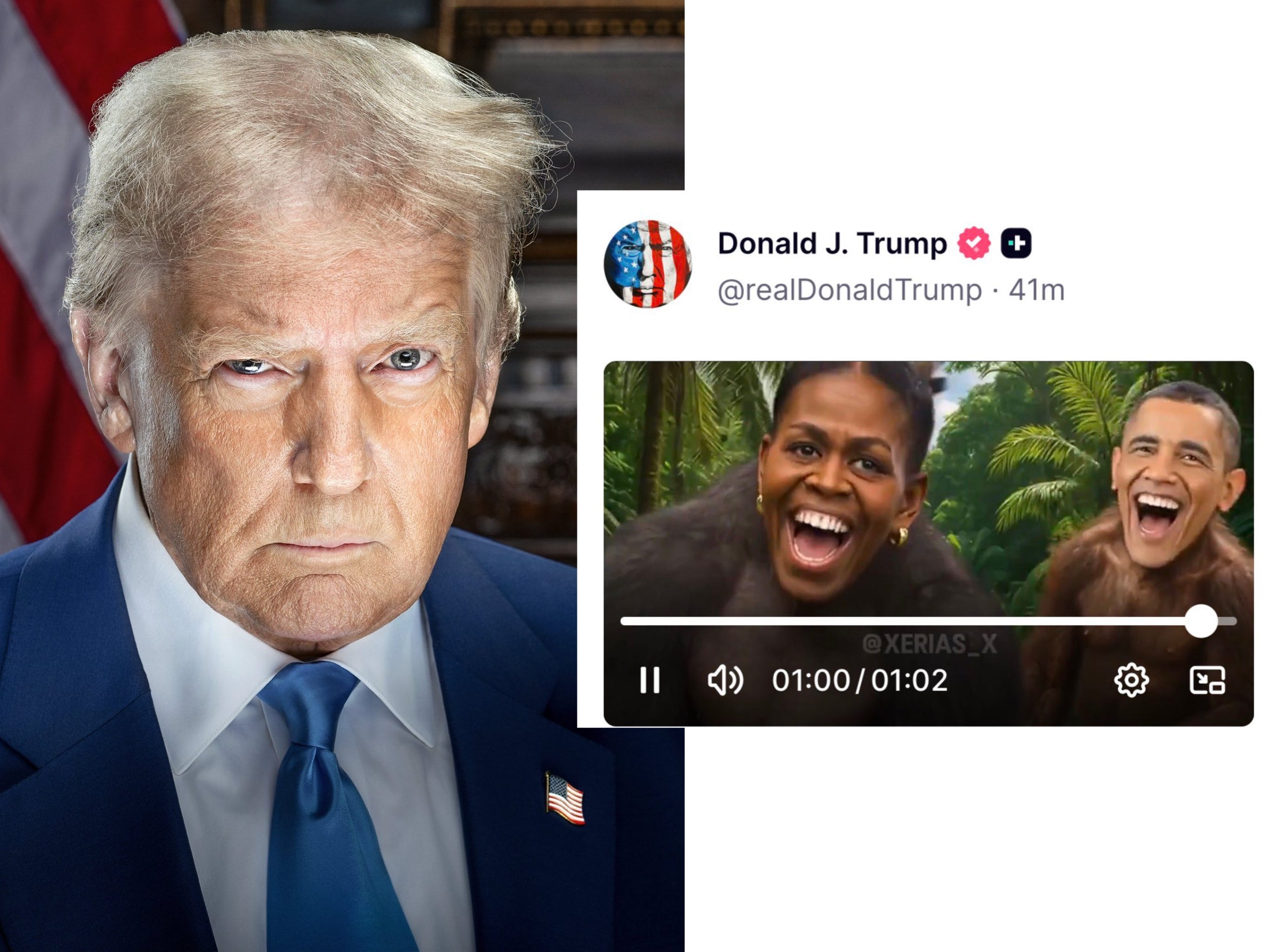
Late Thursday night, February 5, 2026, President Donald Trump posted a video on Truth Social that would spark one of the most significant controversies of his second term. The clip depicted former President Barack Obama and former First Lady Michelle Obama with their faces superimposed onto the bodies of apes—a racist trope with centuries of use to dehumanize Black Americans. The timing made it worse: the first week of Black History Month, targeting America’s first Black president and first lady.
Here’s what happened, how both parties reacted, and what it means.
What Was in the Video
The roughly one-minute video primarily promoted debunked conspiracy theories about the 2020 election and voting machines. But in the final seconds, the Obamas suddenly appeared—their faces placed on primate bodies, mouths wide open, bouncing to “The Lion Sleeps Tonight” from The Lion King.
The video was part of a longer internet meme portraying Trump as a lion (“King of the Jungle”) and various Democrats as other animals. Hillary Clinton appeared as a warthog, Illinois Governor JB Pritzker as an elephant. But only the Obamas were depicted as apes—and Trump’s repost included only that imagery, not the broader “Lion King” context the White House would later cite.
The post went live at 11:44 PM Thursday night. It stayed up for approximately 12 hours before being deleted Friday afternoon.
The White House’s Shifting Story
The White House’s response evolved throughout Friday as pressure mounted:
Friday Morning: Press Secretary Karoline Leavitt dismissed the controversy as “fake outrage,” claiming it was “an internet meme video depicting President Trump as the King of the Jungle and Democrats as characters from the Lion King.” She told reporters to “stop this fake outrage and talk about something that really matters to the American public.”
Friday Afternoon: After bipartisan condemnation, the post was deleted. A White House official said “a staffer erroneously made the post” and blamed the removal on a staff error rather than acknowledging the content.
Friday Evening: Speaking to reporters on Air Force One en route to Mar-a-Lago, Trump claimed he only watched the beginning of the video, which focused on election fraud claims, and then “gave it to the people” (his staff) to post. “I guess somebody didn’t [watch the whole thing], and they posted,” Trump said. “We took it down as soon as we found out about it.”
When asked if he would apologize, Trump was blunt: “No, I didn’t make a mistake.”
When asked if he condemned the racist imagery, Trump said, “Of course I do.”
Republican Reactions: Rare Public Criticism
What made this controversy unusual was the swift condemnation from Republicans who rarely criticize Trump publicly:
Sen. Tim Scott (R-SC), the Senate’s only Black Republican and head of the National Republican Senatorial Committee, delivered the sharpest rebuke: “Praying it was fake because it’s the most racist thing I’ve seen out of this White House.” Scott called for Trump to remove the post.
Trump later told reporters he spoke with Scott on Friday, though he didn’t specify what was said.
Sen. Roger Wicker (R-MS) called the post “totally unacceptable” and said “the president should take it down and apologize.”
Rep. Michael Lawler (R-NY) said the imagery was inappropriate and should be removed.
Sen. Pete Ricketts (R-NE) expressed concern about the post’s content.
Mark Burns, a South Carolina preacher and longtime Trump spiritual adviser, said he spoke to the president Friday and recommended: “That staffer should be fired immediately, and the President should publicly condemn this action.”
According to Axios, the post “roiled” the White House, with staffers receiving calls from fellow Republicans “begging” them to take it down.
Democratic Reactions: Outrage and Condemnation
Democrats were unified and fierce in their condemnation:
House Minority Leader Hakeem Jeffries called Trump “vile, unhinged and malignant” and urged Republicans to “immediately denounce Donald Trump’s disgusting bigotry.” Notably, Jeffries himself has been targeted by Trump’s racist AI-generated content, including a video depicting him wearing a sombrero and fake mustache.
California Governor Gavin Newsom called the video “disgusting” and noted that posting it during Black History Month “says everything about where some in the Republican Party are willing to go.” He urged GOP leaders to “show some basic decency and condemn it.”
NAACP President Derrick Johnson said in a statement: “Donald Trump’s video is blatantly racist, disgusting, and utterly despicable.”
Sen. Chuck Schumer and other Democratic leaders highlighted the historical context, noting that depictions of Black people as apes or monkeys were used to justify slavery, lynching, and Jim Crow laws.
Multiple House Democrats called it “a textbook example of dehumanization” and said it “leans on the oldest, ugliest tropes in American politics.”
The Obamas’ Response
As of publication, neither Barack nor Michelle Obama has publicly commented on the video. Representatives for the Obamas did not immediately respond to media requests for comment.
The silence is notable given the severity of the attack, but also consistent with the Obamas’ general approach of not engaging directly with Trump’s provocations.
Historical Context: Trump vs. Obama
This incident is part of a long pattern:
∙ The “Birther” Movement: Trump was the driving force behind false claims that Obama was born in Kenya and had a forged birth certificate, therefore disqualifying him from the presidency.
∙ Policy Attacks: As president, Trump systematically dismantled Obama’s legacy—exiting the Iran nuclear deal, attempting to repeal Obamacare, and repeatedly blaming Obama for various policy failures.
∙ Previous AI Attacks: In 2025, Trump posted an AI-generated video showing Obama being arrested in the Oval Office and appearing behind bars in an orange jumpsuit.
∙ Pattern of Racist Content: Trump has also shared AI-manipulated videos of other Black political figures, including House Minority Leader Hakeem Jeffries wearing a cartoon sombrero and mustache with mariachi music playing.
The Broader Pattern
This is not an isolated incident but part of Trump’s established pattern of sharing inflammatory, often racist AI-generated content on social media:
∙ Immigrants described as “poisoning the blood” of America (echoing white supremacist rhetoric)
∙ Claims that Vice President Kamala Harris “became” Black
∙ Somali immigrants described as “garbage”
∙ Repeated attacks on DEI (Diversity, Equity, and Inclusion) programs
Since returning to the White House, Trump has issued executive orders eliminating DEI programs across the federal government and ramped up deportations and restrictive immigration policies.
Public Opinion and Accountability
According to sources, public polls show Americans are deeply divided on Trump’s rhetoric, but this particular incident drew unusually broad condemnation, including from Trump allies.
The fact that Trump refused to apologize—and even claimed “I didn’t make a mistake”—reflects his longstanding approach: never admit error, never back down, deflect blame to staff when necessary.
Before Trump entered politics in 2015, it was common for elected officials to face consequences for racist or bigoted comments. Trump has fundamentally changed that dynamic, normalizing language and imagery that would have ended political careers a decade ago.
US Daily Letter Analysis: What This Reveals
This incident is significant for several reasons:
1. The Guardrails Are Gone
The fact that this video stayed up for 12 hours—posted by the President of the United States during Black History Month—shows how thoroughly Trump has normalized content that would have been unthinkable from any previous president. Even Trump’s own staff initially defended it before Republican pressure forced them to backtrack.
2. Republican Complicity vs. Rare Pushback
While some Republicans condemned the post, the vast majority stayed silent. The few who spoke up—Scott, Wicker, Lawler—are notable precisely because they’re exceptions. The Republican Party has largely accepted Trump’s racially inflammatory rhetoric as the price of his political dominance.
3. The “Staffer Did It” Defense
Trump’s explanation—that he only saw part of the video and a staffer posted it—strains credibility. Trump is notoriously hands-on with his social media, often posting late at night himself. The idea that he “gave it to the people” to post without watching the full video suggests either incompetence or plausible deniability.
4. Targeting America’s Symbols
The Obamas aren’t just political opponents—they’re historic figures who represented a milestone in American progress. Attacking them with centuries-old racist imagery during Black History Month isn’t just political combat; it’s a deliberate assault on the idea that America has moved beyond its racist past.
5. The Normalization Continues
Perhaps most troubling: within 24 hours, this story will likely fade from headlines. Trump will post something new. The outrage cycle will move on. And the baseline for acceptable behavior from a sitting president will have shifted once again.
What Happens Next
As of now:
∙ The video has been deleted
∙ No staffer has been publicly identified or fired (despite Burns’s recommendation)
∙ Trump has not apologized and says he won’t
∙ The Obamas have not commented
∙ Congressional Republicans remain largely silent
∙ Democrats have condemned the post but have limited recourse
This is unlikely to result in meaningful consequences for Trump. His approval ratings may dip temporarily, but his base has shown remarkable tolerance for controversial statements and actions.
The real question isn’t whether Trump will face accountability—history suggests he won’t. The real question is what precedent this sets. If a sitting president can post overtly racist imagery targeting a former president during Black History Month, claim ignorance, refuse to apologize, and face no real consequences, what exactly are the limits?
We’re still finding out.
Note to Readers: US Daily Letter aims to provide factual reporting and measured analysis. We recognize this is an emotionally charged topic. We’ve presented the facts as they occurred, the reactions from both parties, and our analysis of what it means for American political discourse. We welcome your thoughts and perspectives.