


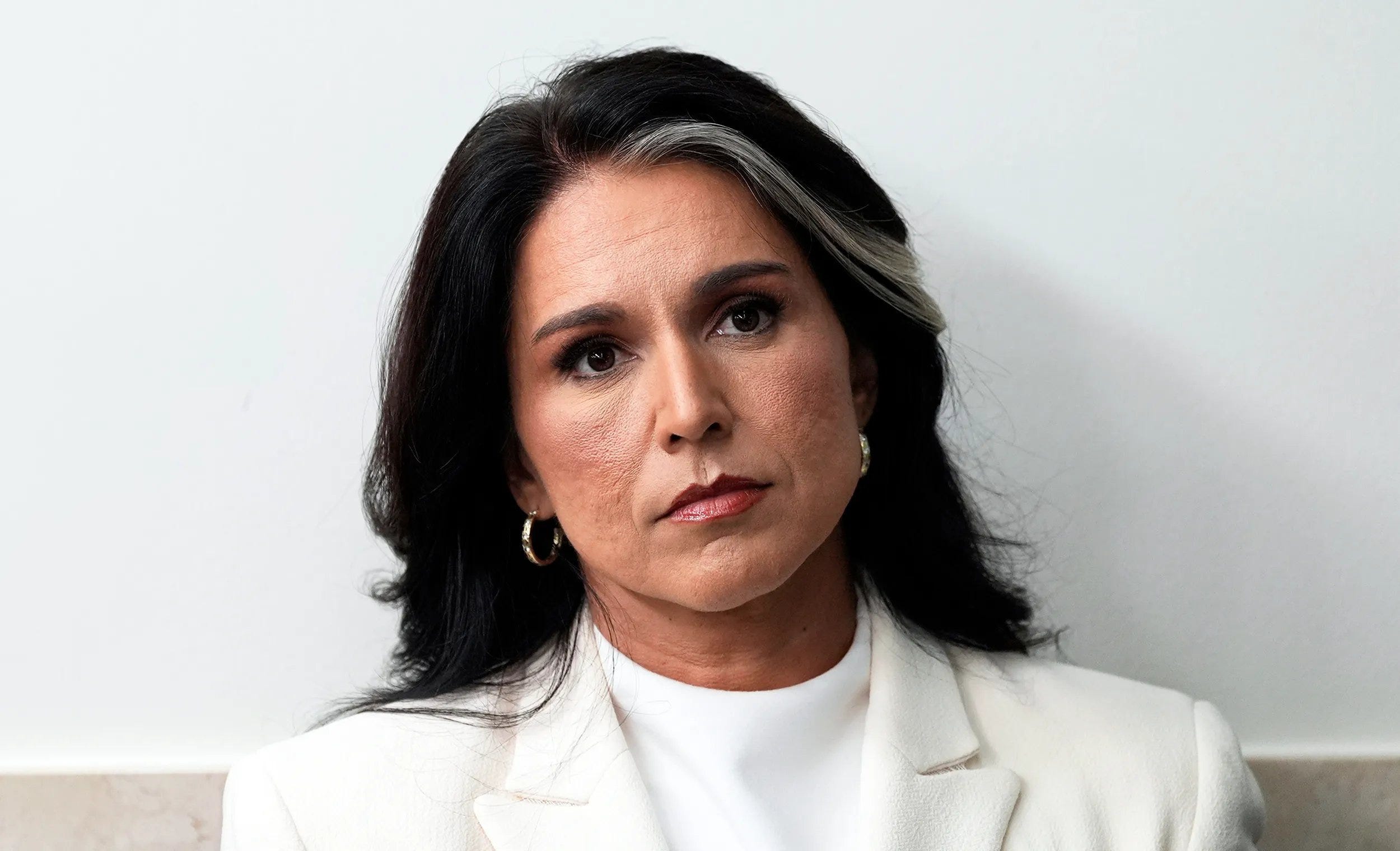
Friday afternoon, Tulsi Gabbard walked into the Oval Office and handed Donald Trump a letter. She was resigning as Director of National Intelligence, effective June 30th. Her husband, Abraham Williams, had been diagnosed with an extremely rare form of bone cancer, and she wrote that she could not let him face it alone. “At this time, I must step away from public service to be by his side and fully support him through this battle,” she said.
Trump posted on Truth Social within the hour. He called her departure unfortunate, praised her work as incredible, and said he had no doubt her husband would “soon be better than ever.” It was gracious. It was warm. And it closed the door on one of the strangest tenures in the history of American intelligence.
Because the full story of Tulsi Gabbard’s 16 months as the nation’s top spy is not really a story about cancer. It is a story about a woman who took a job she was philosophically unqualified to perform, tried to hold herself together inside an administration that did not trust her, and ended up as a footnote to a war she had spent years warning America not to fight.
Who she was before all of this
To understand what just happened, you have to remember who Tulsi Gabbard was before she walked into that confirmation hearing in January 2025.
She was the Hawaii congresswoman who deployed to Iraq, came home, and spent the next decade building a political brand around one central idea: America’s military interventions abroad were reckless, counterproductive, and driven by neoconservatives and warmongers who did not send their own children to fight. She ran for president in 2020 on that message. She sold T-shirts that read “No War With Iran.” She went on Fox News in January 2020, after Trump ordered the assassination of Iranian General Qasem Soleimani, and said: “Speeding towards an all-out war with Iran would make the wars that we’ve seen in Iraq and Afghanistan look like a picnic. It will be far more costly in American lives and American taxpayer dollars, and all towards accomplishing what goal? What objective?”
She endorsed Trump in 2024 because, she said, he would keep America out of new forever wars. She called Joe Biden a warmonger. She said Trump represented the future of American foreign policy: strong, non-interventionist, and focused on the people rather than the political elite.
Then Trump started a war with Iran on February 28th of this year, and the ground beneath Tulsi Gabbard’s entire identity collapsed.
What happened inside the administration
The cracks started showing long before the bombs fell on Tehran.
Gabbard testified to Congress in 2025 that Iran was not building a nuclear weapon, the official assessment of the entire US intelligence community. Trump dismissed it. As Trump was preparing to strike Iran’s nuclear facilities, he was reminded by a reporter that Gabbard had reiterated that assessment. “I don’t care what she says,” Trump responded. When pressed again a couple of days later, he snapped: “She’s wrong.”
The president of the United States publicly repudiating his own Director of National Intelligence on the central intelligence question of the year is not a small thing. It is a statement about where Gabbard stood in the hierarchy of people whose opinions actually shaped policy. The answer was: nowhere near the top.
When Trump ordered military action in Venezuela, Gabbard was not even invited into the White House Situation Room to observe the operation.  The woman whose entire job is to brief the president on threats to American security was not in the room when the president was deciding how to respond to one of those threats. That tells you everything about how much weight her voice carried.
Instead of being part of the major national security decisions, Gabbard focused her energy on pursuing Trump’s political grievances: declassifying documents related to past administrations, appearing at an FBI ballot seizure at an election office in Fulton County, Georgia, and investigating what the administration called Deep State activity inside the intelligence community. She was given a lane that kept her busy and kept her quiet. She stayed in it.
The Joe Kent moment
In March, everything that had been building under the surface came into the open.
Joe Kent, the head of the National Counterterrorism Center and one of Gabbard’s closest political allies, resigned in an open letter stating that he could not in good conscience support the ongoing war in Iran. “Iran posed no imminent threat to our nation,” Kent wrote, “and it is clear that we started this war due to pressure from Israel and its powerful American lobby.”
It was a grenade thrown directly at the administration from inside the intelligence community. And Gabbard was sitting right in the middle of the blast radius.
At a congressional hearing the following day, she refused to condemn Kent. Trump’s response when asked if he still had confidence in her was lukewarm. “Yeah, sure,” he told reporters. “I mean, she’s a little bit different in her thought process than me, but that doesn’t make somebody not available to serve.”
“A little bit different in her thought process” is not how a president describes a trusted cabinet member. It is how he describes someone he is keeping around because firing her would create worse headlines than tolerating her.
Laura Loomer, the far-right activist with close ties to Trump, tried to push the president to fire Gabbard outright. Roger Stone, one of Trump’s oldest allies, reportedly intervened to save her job, warning Trump that Loomer was trying to manufacture a crisis. Tulsi Gabbard’s continued employment as America’s Director of National Intelligence was, at one point, dependent on a back-channel argument between Roger Stone and Laura Loomer.
Let that sink in.
The Iran contradiction she could never escape
Throughout her tenure, Gabbard was pressed repeatedly in Congress on whether she had provided Trump with an honest intelligence assessment showing there was no imminent threat from Iran to justify the war.  Her answers were careful, institutional, and carefully avoided saying what her entire career before this job had trained her to say.
When asked directly whether Iran posed an imminent threat, she told the House Intelligence Committee: “It is not the intelligence community’s responsibility to determine what is and is not an imminent threat.” That statement, from the woman who built her public identity on making exactly those kinds of determinations and shouting them from every media platform available to her, was the sound of a person who had made a choice and was living with its consequences.
The first six days of Operation Epic Fury cost $11.3 billion. At least thirteen American servicemembers were killed. Approximately 200 were wounded. Gabbard, who had once predicted that a war with Iran would make Iraq and Afghanistan look like a picnic, was the principal intelligence advisor to the president who started it.
What her departure actually means
Gabbard is the fourth cabinet member to leave Trump’s second term, following Attorney General Pam Bondi, Homeland Security Secretary Kristi Noem, and Labor Secretary Lori Chavez-DeRemer. The pace of departures at this level of government is notable. Every one of them tells a story about the gap between what Trump said he was building and what he actually built.
Principal Deputy Director of National Intelligence Aaron Lukas will take over in an acting capacity. Lukas is a career intelligence professional, confirmed by the Senate, unknown to the general public. He will do the job quietly and without the ideological drama that defined his predecessor’s tenure. For the intelligence community, which spent 16 months watching its work get publicly dismissed by the president its director served, that may actually be a relief.
As for Gabbard herself, she is leaving with her husband sick and her political identity largely unrecognizable. The woman who sold “No War With Iran” shirts spent the last year and a half defending, in careful bureaucratic language, a war with Iran. She was hired because she seemed like a disruptor who shared Trump’s instincts. She ended up being sidelined precisely because she did not share enough of them when it actually mattered.
She wrote in her resignation letter that Abraham had been her rock through eleven years of marriage, through her deployment to East Africa on a Joint Special Operations mission, through multiple campaigns, through every difficulty their life together had produced.  That part of the letter reads as completely and purely true. Whatever the politics, she is a wife whose husband is seriously ill, and she is going home to him.
The rest of the story is considerably more complicated. And it will be a long time before American history sorts out what to make of what Tulsi Gabbard did and did not do in the room where the decisions were made.
That is what this letter is for.
— US Daily Letter | May 23, 2026