


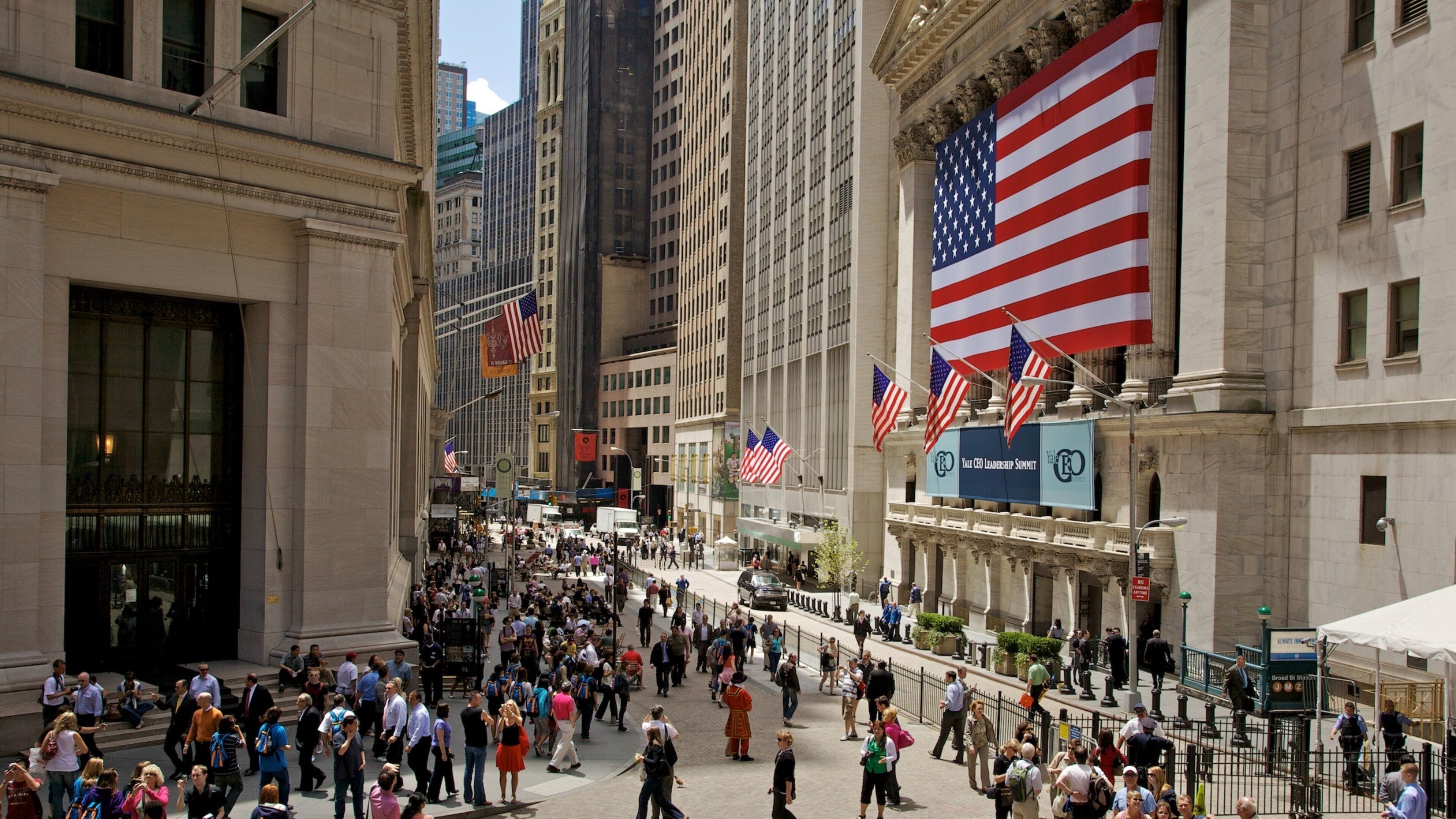
A LETTER FROM WALL STREET
Week of April 21, 2026
Dear Reader,
Wall Street spent last week celebrating what looked like peace. It’s spending this week trying to decide if it was premature.
Here’s the situation as the opening bell rings on Tuesday morning.
THE RALLY THAT ALMOST WAS
Last week, the S&P 500 gained 4.5%, the Dow rose 3.2%, the Nasdaq rallied 6.8%, and the small-cap Russell 2000 jumped 5.6% — a broad-based surge that came on the back of Iran’s brief decision to reopen the Strait of Hormuz.  Indexes hit all-time highs. The Fear & Greed index flipped from Fear to Greed almost overnight. Traders were pricing in a deal.
Then the weekend happened.
Iran had declared that the Strait of Hormuz was reopened — but by Saturday, vessel traffic was restricted again, with state media saying the U.S. had not fulfilled its obligations. On Sunday, the Navy seized an Iranian cargo ship in the Gulf of Oman. The S&P 500 shed 0.24% to close at 7,109.14 Monday, while the Nasdaq’s 13-day winning streak — its longest positive run since 1992 — came to an end.
This morning, however, the mood has shifted again. S&P 500 and Nasdaq futures are up 0.3% and 0.4% respectively, with Dow futures gaining 310 points, as investors focus on a second round of peace talks between the U.S. and Iran in Islamabad. Tehran is reportedly sending a delegation. The ceasefire officially expires today.
The pattern is clear: this market is being held hostage to a single choke point in the Persian Gulf, whipsawing between relief and dread every 48 hours.
EARNINGS SEASON: THE REAL STORY UNDERNEATH THE NOISE
While geopolitics dominates the headlines, corporate America is quietly delivering. And the numbers are good.
Q1 2026 earnings growth is running at +12.6% year-over-year — the sixth consecutive quarter of double-digit growth, with tech driving 87% of the gains. That’s the underlying foundation the bulls keep pointing to, and they’re not wrong to do so.
Analyst estimates for full-year S&P 500 profits continue to trend higher — up 2.8% since the start of the Iran conflict, driven by upward revisions in energy, technology, and materials. Even war, it turns out, is good for some balance sheets.
This week is the densest stretch of the season. Noteworthy firms reporting include Tesla, Intel, IBM, Boeing, GE Aerospace, UnitedHealth, AT&T, American Express, and United Airlines. Each of them is a different kind of diagnostic. Boeing tells you about industrial recovery. United Airlines tells you whether the Iran war is hitting travel demand. UnitedHealth tells you about healthcare costs. Tesla tells you about EV demand — and whether Elon Musk’s political detours have cost him customers.
UnitedHealth shares jumped more than 6% in pre-market trading this morning after the health insurance giant posted better-than-expected quarterly earnings and hiked its full-year outlook — a strong early signal for the week.
The bigger question, though, isn’t whether companies beat their Q1 numbers. It’s what they say about Q2 and Q3. If companies cite the Iran war’s impact on supply chains or temper their forward guidance due to demand uncertainty, it could undercut the rally narrative even if Q1 beats expectations. Watch for the word “ceasefire” in earnings calls. When CEOs start hedging around geopolitics, that’s the canary.
THE FED: A NEW SHERIFF IN TOWN — MAYBE
As if the market didn’t have enough to process, the Federal Reserve is also in focus today in a very different way.
Kevin Warsh, President Trump’s pick to succeed Jerome Powell as Fed Chair, is testifying before the Senate Banking Committee this morning. Powell’s term expires May 15. The succession clock is ticking.
Warsh spent years criticizing the Fed for doing too much. More recently, he has suggested it may need to do the opposite — putting him squarely in the middle of a tug-of-war between appeasing Trump and protecting Fed independence.
In his prepared remarks, Warsh emphasized the importance of central bank independence, warning against political encroachment: “The Fed must stay in its lane.” Notably absent from those same remarks: any firm statement on where interest rates should go from here.
That silence is itself a signal. Inflation has been running above the Fed’s 2% target for five years, and with another price shock now coming from elevated oil prices, the case for near-term rate cuts is weak — regardless of what the President wants.
The political drama adds another layer: Republican Senator Thom Tillis has vowed to block Warsh’s confirmation until a DOJ probe into Jerome Powell is resolved, meaning a swift confirmation is unlikely. If Powell isn’t replaced by May 15, he stays as chair pro tempore. Markets hate that kind of limbo.
THE APPLE HEADLINE YOU ALMOST MISSED
Buried under the geopolitical noise: Apple named John Ternus as its next CEO, with the stock falling about 0.6% in extended trading on the announcement. Ternus, currently Apple’s SVP of Hardware Engineering, is the man who will be holding the iPhone when it folds — literally. He is set to take over on September 1, 2026, positioning him to lead the launch of the company’s first foldable iPhone just weeks after taking the helm.
The market’s muted reaction tells you everything: investors respect the internal promotion but are reserving judgment. Tim Cook’s shoes are famously difficult to fill. The foldable iPhone will be Ternus’s first real test.
THE BOTTOM LINE FOR YOUR PORTFOLIO
Three things are true at once right now, and they pull in different directions.
Corporate earnings are strong. The underlying economy, buffered in part by roughly $200 billion in household stimulus from the new tax bill — including average tax refunds up 11% to $3,500 — is cushioning the blow of higher energy prices on consumers. That’s genuine support for the bull case.
At the same time, oil at $88–$95 a barrel is a persistent tax on everything. Every week the Strait of Hormuz stays contested, that tax compounds.
And the Federal Reserve, whatever happens at today’s hearing, is not riding to the rescue anytime soon. Rate cuts require confidence that inflation is beaten. With energy prices elevated and a new Fed chair navigating a political minefield, that confidence is months away at best.
The market is not in freefall. But it is running on hope — hope that the ceasefire holds today, hope that earnings guidance doesn’t crack, hope that Warsh threads the needle between Trump and independence. That’s a lot of hope for a Tuesday morning.
Stay sharp.
— US Daily Letter | From Wall Street