


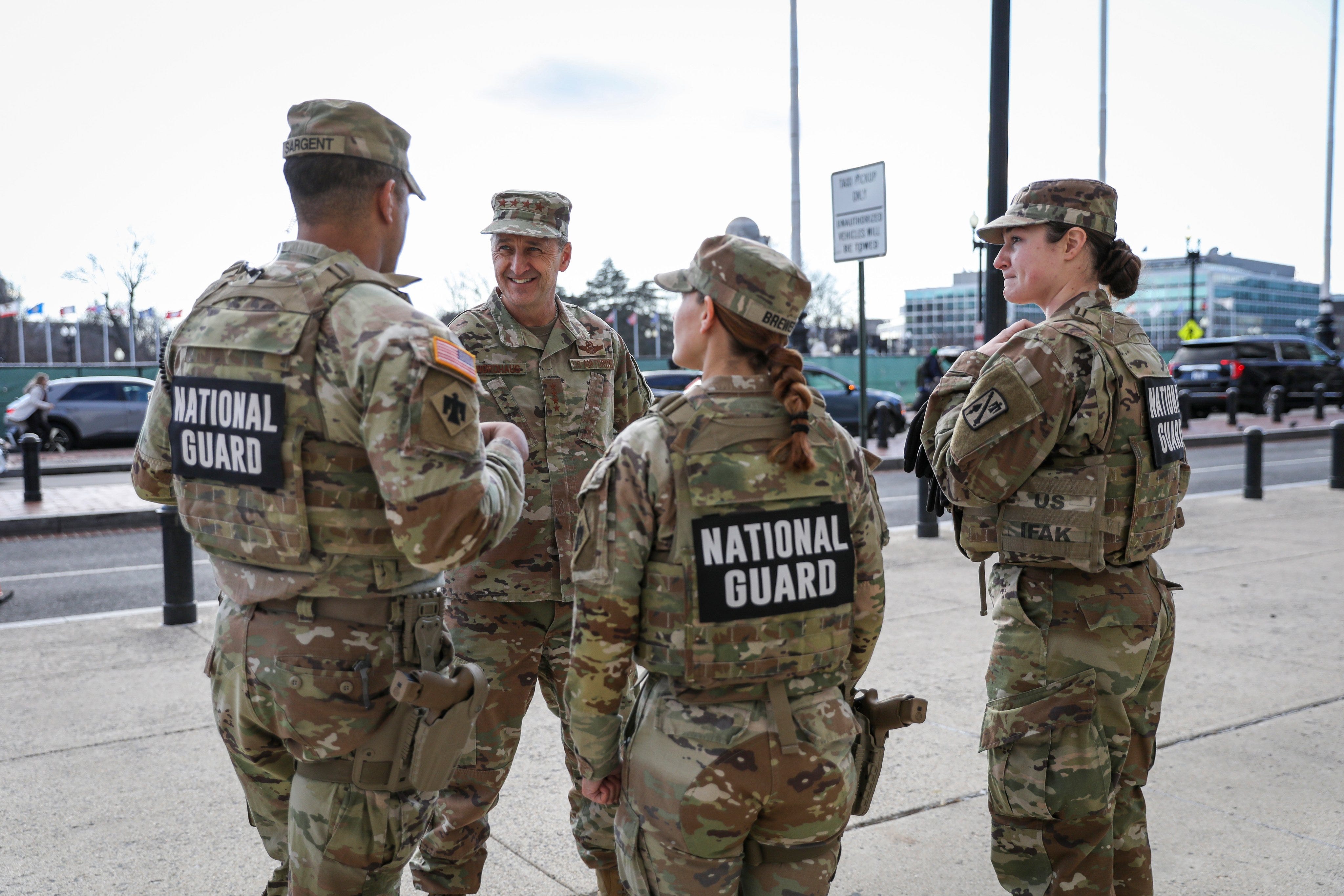
In early June, President Donald Trump issued an executive order authorizing the federal deployment of state National Guard troops, asserting protesters in “numerous incidents” were preventing federal agents from enforcing immigration law.
California National Guard troops were soon sent to Los Angeles at the direction of federal officials.
“Ultimately, about 4,000 troops from the California National Guard and 700 U.S. Marines were deployed to Los Angeles,” CalMatters reports.
The deployment was a precursor to several ongoing legal fights over Trump’s use of National Guard troops. The most notable of those lawsuits center on deployments and attempted deployments to Los Angeles, Chicago and Portland, Oregon.
Last Thursday, Trump called off deploying to San Francisco federal agents and troops, including National Guard troops, who, according to news reports, were gathering at a nearby Coast Guard base.
National Guard troops are normally under state control, with the governor serving as commander-in-chief. There are National Guard units in every state, the District of Columbia, Guam, Puerto Rico and the U.S. Virgin Islands.
Under certain circumstances, National Guard troops can be federalized, where they become part of the active national military and, ultimately, under command of the president. District of Columbia National Guard troops always report to the president.
As Trump continues to threaten to deploy the National Guard in major U.S. cities, journalists can ground audiences with facts — providing context about the Guard’s history, how it has operated at the state and federal levels, and the legal arguments made by ongoing lawsuits regarding attempts to federalize those troops. Read on to learn about:
When can the president take control of state National Guard troops?
What legal arguments are relevant to recent National Guard deployments?
When can the president take control of state National Guard troops?
There are two branches of the National Guard: The Army National Guard and the Air National Guard. By federal law, “National Guard” refers to both. While the history of the National Guard traces to before the country’s founding, the Militia Act of 1903 established the modern Guard and was the legal precursor for the three situations today in which the president can federalize state troops:
If any part of the U.S. is invaded or under threat of invasion from a foreign nation.
If there is a rebellion or danger of rebellion against the U.S. government.
If the president cannot execute federal laws using “regular forces.”
Sometimes during natural disasters, National Guard troops are deployed under a hybrid status where they are paid by the federal government but remain under state control. This typically happens by request of or with the consent of a state’s governor.
Before the June executive order, presidents had federalized Guard troops for 10 other domestic missions since World War II and none since the 1992 Los Angeles riots, according to a National Guard reportreleased in June.
California Gov. Gavin Newsom did not consent to the June deployment to Los Angeles.
Past presidents federalized National Guard troops five times without gubernatorial consent. There were four instances during the integration of public schools in the South, from 1957 to 1963, with federalized National Guard troops protecting and allowing Black students to attend high schools and colleges. Alabama National Guard troops also escorted protesters facing violence during one of the Selma-to-Montgomery civil rights marches of 1965.
The latter was “the last time the president federalized a state National Guard without its governor’s permission or request until 2025,” according to the report.
Presidents have typically invoked the Insurrection Act when federalizing National Guard troops, but Trump did not in June. Despite suggesting numerous times that he might invoke the Insurrection Act in order to federalize National Guard troops, Trump has not, so far, used the act to send military troops into U.S. cities this year.
The Insurrection Act comprises a variety of laws passed from 1792 to 1871, according to an analysis by counsel Joseph Nunn of The Brennan Center for Justice at New York University. The laws commonly referred to as the Insurrection Act are codified in Chapter 13 of Title 10.
Trump’s executive order from June relied on Title 10 Section 12406 of U.S. code to federalize National Guard troops. That section of federal statute reflects the language of the Milita Act of 1903.
The Insurrection Act also allows federal troops to perform civilian law enforcement functions. Title 18, Section 1385 of the U.S. code, commonly referred to as the Posse Comitatus Act, prohibits military troops from engaging in domestic law enforcement.
“Posse Comitatus” is Latin for “the power of the county,” referring to local law enforcement officials, such as sheriffs and federal marshals, enlisting the help of regular citizens to enforce laws — particularly as the country expanded west in the 19th century.
The Posse Comitatus Act was passed in 1878. As a federal law, the act only applies to the National Guard when those troops are federalized, according to a 2024 report from the Congressional Research Service.
The Insurrection Act and the Posse Comitatus Act are two of the most important laws being argued in ongoing lawsuits about Trump’s National Guard deployment attempts.
Today, the National Guard is, by law, an organized militia. The National Guard Bureau is the communications and coordination channel for the National Guard, the Department of Defense and states. The operational command — who is in charge of National Guard actions — depends on the legal status invoked at any given time.
Usually, the National Guard operates under what is called “state active duty status,” which, according to federal regulation, is defined by state law. This is the usual status, under which the state governor is commander-in-chief.
Under “Title 10 status,” National Guard troops have been called into federal service, and the president is commander in chief. Title 32 of U.S. code allows for “hybrid status,” writes Nunn of the Brennan Center.
Under hybrid status, “the Guard remains under state command and control but can perform federal missions, is paid with federal funds, and receives federal benefits,” Nunn writes, adding that the original purpose of the hybrid status was to allow for federal funding of training requirements.
Title 32 is sometimes invoked for natural disaster response, allowing federal funding but maintaining state control of Guard troops, explains Andrea Katz, an associate professor of law at Washington University in St. Louis, in The Conversation.
In short, National Guard troops can serve both state and federal functions, including:
Supplementing active-duty military forces during war abroad, in combat and support roles.
Assisting during domestic crises, such as hurricanes, floods and other disasters.
Serving as domestic law enforcement, in certain circumstances, such as during civil uprisings.
The Armed Forces Reserve Act of 1952 allowed the president to federalize the National Guard without a Congressional declaration of national emergency, paving the way for federal Guard deployments during school integration efforts in the 1950s and 1960s and the several other deployments since then.
How old is the National Guard?
The National Guard traces its history to the 17th century, to three militia regiments organized in Massachusetts. Regiments were reorganized over the ensuing centuries.
The original three exist today as the 181st and 182nd Infantries, the 101st Field Artillery and the 101stEngineer Battalion, all of the Massachusetts National Guard.
In 2013, Congress designated, by law, Salem, Massachusetts as the birthplace of the National Guard. The first U.S. militia was organized in 1629 by Capt. John Endicott, according to the law, with the Massachusetts General Court ordering in 1636 that the three formal militia regiments be organized.
The 101st Engineer Battalion was organized on Salem Common in 1637, “marking the beginning of the Massachusetts National Guard and the National Guard of the United States,” according to the law.
How big is the National Guard?
At the time of a 2023 Department of Defense report, the latest available, there were about 325,000 Army National Guard selected reserve members — meaning those actively ready to serve if a governor or the president mobilizes them — and nearly 105,000 selected reserve members of the Air National Guard.
There were about 1.3 million active-duty troops, including the Coast Guard, with the Army making up the largest share at 35%, followed by the Navy and Air Force at about 25% each and the Marine Corps at about 14%, at the time of the report.
Separate from National Guard troops, the Army, Navy, Marine Corps, Air Force and Coast Guard also count about 337,000 selected reserve personnel, who are usually part-time and respond to national emergencies — though reservists may also be called to respond to state emergencies.
The important distinction is that National Guard troops report to state governors, unless they are federalized, while reservists report to the president, same as active duty, full-time personnel.
What laws established the modern National Guard?
The Militia Act of 1903 was passed on the heels of U.S. victory in the Spanish-American War. Volunteer militia soldiers participated in battles in the Pacific and the Caribbean, and made up most of the troops sent to Puerto Rico and the Philippines, writes military historian Michael D. Doubler in his 2003 book, “Civilian in Peace, Soldier in War.”
At the outset of Spanish-American War, in April 1898, there were about 26,000 enlisted Army soldiers. Following President William McKinley’s call for volunteers, the regular Army swelled to over 56,000 while the volunteers numbered over 200,000 by the time the war ended in August, according to a subsequent presidential commission report.
Despite the victory, “inefficiency, waste, and scandal characterized the mobilization and the logistical support of field forces,” Doubler writes. “Newspaper reporters investigated the mobilization thoroughly and presented their readers with graphic illustrations of poor planning and outright incompetence.”
The presidential commission ultimately blamed huge amounts of paperwork and general military unpreparedness, with troops lacking “any large stock of arms, ammunition, clothing, supplies and equipments.”
One major conclusion of the report was that the country should generally be better prepared for war. That led to an effort to reorganize the War Department, the predecessor to the Department of the Army, which is part of the Department of Defense.
McKinley gave the task to War Secretary Elihu Root, a Wall Street lawyer “intimately familiar with corporate reorganization and international law,” according to Doubler.
While Root successfully increased the number of standing Army troops, there was little appetite in Congress for the massive expansion in numbers that Root wanted, and “the War Department still lacked sound plans for raising a mass, national Army for a possible war against one of the European powers,” Doubler writes.
The public, however, was receptive to the idea of the citizen-soldier — the militia member — considering that 20 such soldiers were awarded the Medal of Honor for fighting in the Philippines during the Spanish-American War. When the Militia Act of 1903 was passed, formally establishing the National Guard, there were more than 116,000 largely volunteer militia members across the states, according to Doubler.
The Militia Act of 1903 limited to nine months the amount of time the president could federalize National Guard troops. The Militia Act of 1908 removed that time limit and ordered that by 1910 the National Guard should have the same “organization, armament and discipline” as the Army, further professionalizing the nation’s organized militia.
Finally, the National Defense Act of 1916 allowed the ranks of National Guard troops to expand, clarified that Guard troops would serve as part of the active military during national emergencies, and allowed them to serve overseas.
By World War I, “the National Guard was an active instrument of American foreign policy and a more effective combat reserve of the U.S. Army,” Doubler writes.
What legal arguments are relevant to recent National Guard deployments?
On Aug. 11, Trump deployed the District of Columbia National Guard throughout the district to fight crime, despite falling crime rates there. The District of Columbia National Guard, unlike state National Guards normally, reports to the president.
“[W]hen they’re mobilized by the president pursuant to his role as their commander, not as the president federalizing them, they are not technically federalized, they’re still D.C. National Guard,” Brookings Institution governance studies fellow Scott R. Anderson explained in September. “That means they’re not subject, at least in the views of the executive branch, although it’s been a longstanding view at this point, they’re not subject to Posse Comitatus Act limitations in the same way and they can participate in different types of law enforcement.”
Local and state officials have publicly opposed deployments or attempted deployments in Chicago, Portland, Memphis and Los Angeles. Tennessee Gov. Bill Lee sent his National Guard troops to Memphis in mid-October, at the urging of the president, meaning those troops remain under state, not federal, control.
On Oct. 9, a federal appeals court judge temporarily blocked Trump from federalizing the Illinois National Guard and deploying 500 of those troops to Chicago. Noting that protesters outside of a Chicago processing center for immigrants never numbered more than 200, Judge April Perry reportedly said, “I have seen no credible evidence that there is a danger of rebellion in the state of Illinois,” while issuing her ruling.
In other words, the judge did not agree with the administration that situation there was one under which the president could federalize National Guard troops. On Oct. 22, the judge indefinitely extended her restraining order until her court or the U.S. Supreme Court decides otherwise.
On Oct. 20, a three-judge appellate court panel halted a lower court order preventing Trump from deploying Oregon National Guard troops to Portland. But Oregon troops have not been sent there yet, as the court considers another restraining order preventing them from being deployed.
In September, a U.S. district judge ruled that the June federalization and deployment of National Guard troops to Los Angeles violated the Posse Comitatus Act, citing Guard troops performing law enforcement functions such as setting up traffic blockades and engaging in crowd control. Judges in the 9th U.S. Circuit Court of Appeals are considering whether the president’s power to deploy National Guard troops can be reviewed by courts, brought on by the Los Angeles deployment.
“No one disputes that Trump under the Militia Act is authorized to decide whether to federalize state national guard members should the United States be invaded by Spain, the former Confederate States repeat their attempt at secession, or massive riots close all federal courts in Texas,” writes University of Maryland professor Mark Graber in a 2025 article in The Journal of the Civil War Era.
However, Graber continues, “The Militia Act was intended to empower the president to federalize the state militia to confront military forces or the equivalent of military forces. That measure gave the president no power to federalize state militia to confront sporadic violence by protestors who do not resemble in any way a military force.”
About The Author

Clark Merrefield
Clark Merrefield is the senior editor for economics and legal systems at The Journalist’s Resource. He joined JR in 2019 after working as a reporter for Newsweek and The Daily Beast, as a researcher and editor on three books related to the Great Recession, and as a federal government communications strategist. He has been selected for fellowships in juvenile justice and solitary confinement at the John Jay College of Criminal Justice and his work has been awarded by Investigative Reporters and Editors. @cmerref